TLS Proxies Explained: How Secure Proxy Connections Work in 2026
 2026.07.12 23:46
 petro
petroProxy servers have become an important part of modern network infrastructure. They are used to route traffic, control access, protect backend systems, manage business networks, test applications, support authorized data-collection workflows, and integrate with advanced browser environments such as BitBrowser for multi-account management and fingerprint isolation.
However, most modern web traffic is encrypted with Transport Layer Security, commonly known as TLS. This raises an important question: how can a proxy process traffic when the connection between a client and a website is encrypted?
The answer depends on the type of TLS proxy being used.
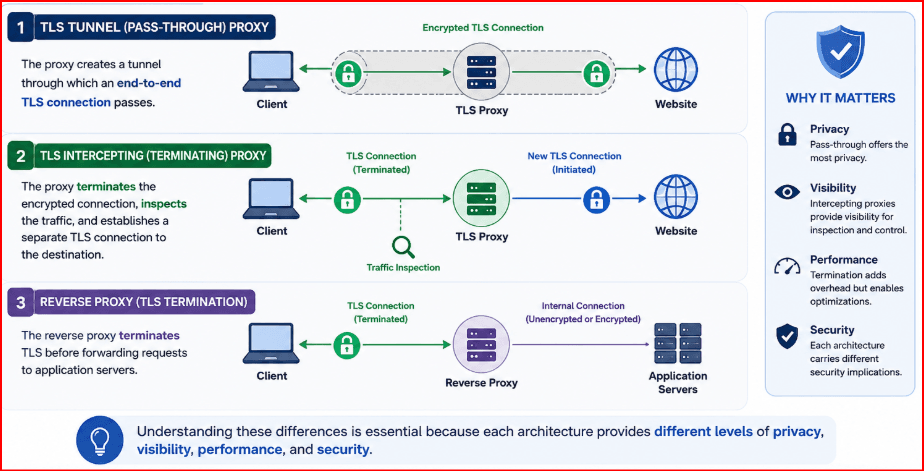
Some proxies simply create a tunnel through which an end-to-end TLS connection passes. Others terminate the encrypted connection, inspect the traffic, and establish a separate TLS connection to the destination. Reverse proxies can also terminate TLS before forwarding requests to application servers. Tools like BitBrowser often rely on TLS-compatible proxies to ensure secure, isolated browsing sessions across multiple identities.
Understanding these differences is essential because each architecture provides different levels of privacy, visibility, performance, and security.
What Is TLS?
Transport Layer Security is the cryptographic protocol used to protect communications between applications across an untrusted network.
TLS is designed to provide three primary protections:
- Confidentiality: Traffic is encrypted so unauthorized parties cannot easily read it.
- Integrity: Changes made to the transmitted data can be detected.
- Authentication: Digital certificates help clients verify the identity of the server.
TLS is most commonly associated with HTTPS, which is HTTP transmitted through a TLS-secured connection.
As of July 2026, the current IETF specification for TLS 1.3 is RFC 9846. It replaced the earlier TLS 1.3 specification in RFC 8446 and formally obsoleted the original TLS 1.2 specification, while still defining requirements for implementations that continue to support TLS 1.2.
Older TLS 1.0 and TLS 1.1 versions have already been formally deprecated because they lack support for modern recommended cryptographic mechanisms.
What Is a TLS Proxy?
The term TLS proxy generally describes a proxy server that participates in, transports, terminates, or manages TLS-encrypted connections.
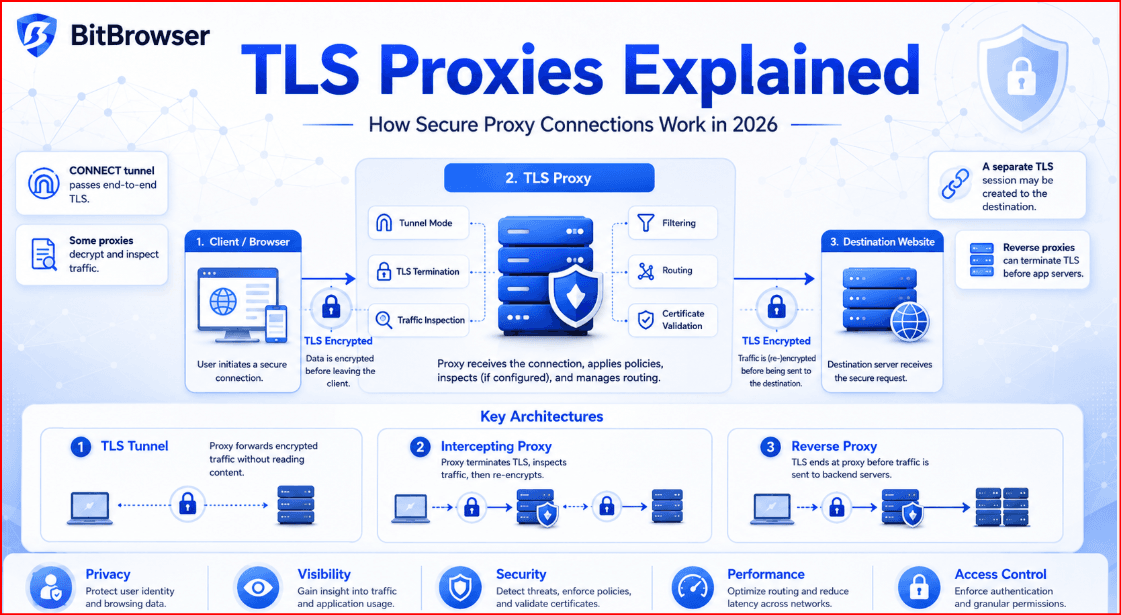
It is not always a single, clearly defined proxy category. Different providers and network administrators may use the term to describe several architectures, including:
- An HTTP proxy that tunnels HTTPS traffic
- A proxy whose client-facing connection is protected by TLS
- A TLS inspection or interception proxy
- A reverse proxy that terminates TLS
- A security gateway that filters encrypted business traffic
Because the term can have different meanings, users should examine how a proxy handles encryption rather than relying only on the product label.
How a Standard HTTPS Proxy Tunnel Works
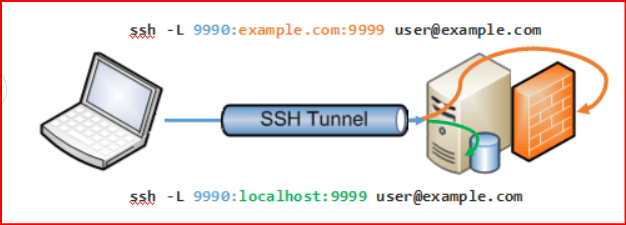
One of the most common ways to route HTTPS traffic through a proxy is with the HTTP CONNECT method.
The process generally works as follows:
- The client connects to the proxy server.
- The client asks the proxy to open a connection to a destination host and port.
- The proxy connects to the requested destination.
- After the request is accepted, the proxy begins relaying data in both directions.
- The client performs the TLS handshake directly with the destination server through the tunnel.
- Encrypted application data passes through the proxy.
HTTP standards allow clients to connect to an HTTP or HTTPS proxy and direct requests through that intermediary. The CONNECT method is specifically used to establish a tunnel to a remote host.
In this architecture, the proxy normally does not decrypt the HTTPS content. It primarily transports the encrypted TLS records between the client and the destination.
What the proxy may still see
Even when the content remains encrypted, the proxy may still observe connection-related information such as:
- The client’s IP address
- The requested destination host or IP
- The destination port
- Connection times
- Session duration
- Traffic volume
- Authentication details sent directly to the proxy
The proxy normally cannot read encrypted page content, passwords, API payloads, cookies, or other application data carried inside a correctly validated end-to-end TLS connection.
TLS-Protected Connections to the Proxy
An HTTPS proxy can also use TLS between the client and the proxy itself.
This creates an encrypted client-to-proxy connection. If the client then opens a CONNECT tunnel to an HTTPS destination, two security layers may effectively be involved:
- A TLS connection between the client and the proxy
- A separate end-to-end TLS connection between the client and the destination through the tunnel
Protecting the first connection is especially important when proxy authentication credentials are transmitted. Basic authentication credentials are encoded rather than encrypted by the authentication scheme itself, so they need a protected transport connection to prevent interception.
This architecture reduces the risk of local network observers seeing proxy credentials or the commands exchanged between the client and proxy.
However, encrypting the client-to-proxy connection does not automatically make the proxy operator trustworthy. The provider still controls the proxy infrastructure and may retain connection metadata according to its technical configuration and logging policy.
What Is a TLS Inspection Proxy?
A TLS inspection proxy operates differently from a simple tunnel.
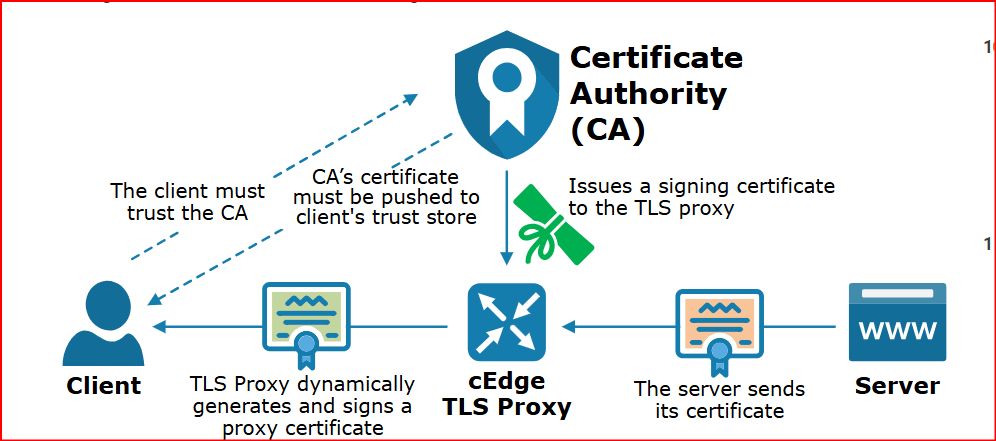
Instead of allowing the client to negotiate TLS directly with the destination, the inspection proxy places itself between the two systems.
The architecture creates two separate connections:
- A TLS connection between the client and the proxy
- A different TLS connection between the proxy and the destination server
The proxy decrypts traffic from the first connection, processes or inspects the plaintext, and then encrypts it again before forwarding it through the second connection.
This approach is sometimes called:
- TLS interception
- HTTPS inspection
- SSL inspection
- Break-and-inspect
- TLS termination and re-encryption
Although the term “SSL inspection” remains widely used, modern systems should use TLS rather than the obsolete SSL protocols.
Why Organizations Use TLS Inspection
Authorized enterprise networks may use TLS inspection for legitimate security and administrative purposes.
Common applications include:
Malware detection
Encrypted downloads and application traffic can carry malicious files. An inspection gateway can scan permitted traffic before it reaches managed devices.
Data-loss prevention
Organizations may inspect outbound traffic to detect unauthorized transmission of confidential business information.
Access-policy enforcement
A proxy can apply rules based on URLs, request types, file categories, user identities, or destination services.
Incident investigation
Security teams may need greater traffic visibility when investigating suspicious activity on systems they manage.
Regulatory and operational controls
Some organizations need monitoring controls to support internal security requirements, fraud detection, troubleshooting, or compliance processes.
TLS 1.3 strengthened forward secrecy, which protects previous communications even if a server is later compromised. However, this also limits older passive-decryption techniques used by some enterprise monitoring systems. NIST’s TLS 1.3 visibility guidance discusses standards-compliant approaches for organizations that need authorized monitoring within controlled enterprise environments.
How a TLS Inspection Certificate Works
A client normally expects a website to present a certificate issued by a trusted certificate authority.
A TLS inspection proxy cannot generally present the destination website’s real private key because it does not possess that key. Instead, the proxy dynamically creates a replacement certificate for the requested domain and signs it with an organizational certificate authority.
For the connection to succeed without warnings, the device must trust the organization’s root certificate.
This means inspection should generally be limited to authorized environments where:
- The organization controls the device
- The root certificate is securely deployed
- Users are appropriately informed
- Inspection is permitted by applicable policies and laws
- Sensitive categories are handled according to organizational requirements
Applications that use certificate or public-key pinning may reject the proxy-generated certificate, even when the device trusts the organization’s certificate authority. Pinning is specifically designed to restrict which certificates or public keys an application accepts.
TLS Tunneling vs. TLS Inspection
The main difference concerns where the encrypted connection ends.
TLS tunneling
With tunneling, the client establishes TLS with the destination server through the proxy.
The proxy transports encrypted data but does not normally decrypt the application content.
This architecture is better suited to situations where the goal is traffic routing, IP presentation, geographic access, or connection management without examining the encrypted payload.
TLS inspection
With inspection, the client’s TLS connection ends at the proxy. The proxy decrypts the traffic and starts another TLS connection to the destination.
This provides greater visibility and policy control, but it also increases security responsibility because the proxy temporarily handles plaintext data.
Reverse Proxies and TLS Termination
TLS proxies are not limited to outbound client traffic.
A reverse proxy is positioned in front of one or more application servers. Users connect to the reverse proxy rather than directly to the backend infrastructure.
The reverse proxy may:
- Receive HTTPS connections
- Present the website’s certificate
- Terminate TLS
- Apply security policies
- Balance traffic across backend servers
- Cache responses
- Forward requests to internal applications
The connection from the reverse proxy to the backend can be:
- Unencrypted within a trusted internal environment
- Protected by another TLS connection
- Protected with mutual TLS for stronger service authentication
Terminating TLS at a reverse proxy can centralize certificate management and reduce the number of systems on which private keys must be stored. OWASP notes that TLS termination at a reverse proxy can also help limit the distribution of sensitive wildcard private keys.
For security-sensitive environments, encrypting traffic between the reverse proxy and backend services is generally preferable, particularly when those systems communicate across separate networks, cloud environments, or data centers.
TLS Proxy vs. HTTPS Proxy
The terms are related but not always interchangeable.
An HTTPS proxy commonly refers to either:
- A proxy reached through an HTTPS-encrypted connection
- An HTTP proxy capable of tunneling HTTPS traffic with
CONNECT
A TLS proxy is a broader term. It may refer to any proxy that manages TLS sessions, including inspection gateways and reverse proxies.
Before selecting a service, determine:
- Whether the connection to the proxy is encrypted
- Whether the proxy supports HTTPS tunneling
- Whether TLS remains end-to-end
- Whether the proxy decrypts traffic
- Which TLS versions are supported
- How certificates are validated
- Whether DNS requests are protected
- What data the operator logs
Common Uses for TLS Proxies
Secure business browsing
Organizations can route managed-device traffic through a protected gateway to enforce security and access policies.
API communication
Developers may use authenticated proxies to route HTTPS API requests through approved network infrastructure.
Web application testing
Security and quality-assurance teams can use authorized inspection proxies to observe requests, responses, headers, cookies, and API behavior in applications they own or are permitted to test.
Web scraping and data collection
TLS-capable proxies allow compliant automation systems to access HTTPS resources while presenting the proxy’s network address to the destination.
The proxy does not remove website restrictions or grant permission to collect data. Users must still follow applicable terms, access controls, robots directives, privacy requirements, and rate limits.
Reverse-proxy protection
Websites can use TLS-terminating reverse proxies for load balancing, web application firewalling, caching, authentication, and protection of origin infrastructure.
Network troubleshooting
Administrators may use authorized proxy logs and inspection tools to diagnose certificate failures, API errors, blocked destinations, and application compatibility problems.
Security Benefits of TLS Proxies
When correctly configured, TLS-aware proxies can provide several benefits.
Protection against local interception
TLS encryption helps prevent attackers on untrusted networks from reading traffic exchanged between authenticated endpoints.
Centralized certificate management
Reverse proxies can centralize certificate installation, renewal, and secure-key handling.
Policy enforcement
Enterprise proxies can apply consistent network controls across managed devices.
Origin isolation
A reverse proxy can conceal backend server addresses and prevent users from connecting directly to protected application infrastructure.
Authentication
A proxy can require usernames, tokens, IP allowlists, client certificates, or other access controls before accepting traffic.
Better security monitoring
Authorized inspection can help security teams detect threats that would otherwise remain hidden inside encrypted sessions.
Risks and Limitations
TLS proxies also introduce important risks.
The proxy becomes a trust point
All routed traffic depends on the proxy’s security, availability, and operational practices.
A compromised proxy may expose connection metadata or, in an inspection architecture, decrypted content.
Certificate-validation failures
Improper certificate checking can allow connections to impersonated or misconfigured destinations.
A secure proxy should validate destination certificates, hostnames, expiration dates, trust chains, and revocation information where supported.
Weak protocol support
A proxy that relies on obsolete TLS or outdated cryptographic configurations can weaken the security of the overall connection.
Sensitive data exposure
Inspection proxies may process passwords, authentication cookies, personal information, payment data, and confidential business content.
This creates substantial security, privacy, and governance responsibilities.
Logging risks
Connection logs can reveal browsing activity, service usage, destinations, timestamps, and traffic patterns even when payload content is not stored.
Compatibility problems
Certificate pinning, mutual TLS, custom applications, non-HTTP protocols, HTTP/3, and certain authentication systems may not work correctly through an intercepting proxy.
Performance overhead
TLS handshakes, certificate generation, traffic scanning, and re-encryption consume computing resources and may add latency.
How to Evaluate a TLS Proxy Provider
A professional evaluation should examine more than IP-pool size or advertised speed.
Confirm the proxy architecture
Determine whether the service offers:
- End-to-end tunneling
- TLS to the proxy
- TLS interception
- Reverse-proxy termination
- Re-encryption to the destination or backend
Check supported TLS versions
TLS 1.3 should be preferred wherever compatible. Legacy TLS 1.0 and TLS 1.1 should not be accepted.
TLS 1.2 may remain necessary for compatibility with older systems, but its configuration should avoid weak algorithms and obsolete options.
Review certificate validation
The proxy must validate destination certificates rather than blindly connecting to any server presenting a certificate.
Examine authentication
Look for secure authentication options such as:
- Rotating credentials
- Strong passwords
- Token-based access
- IP allowlisting
- Mutual TLS
- Restricted user permissions
Understand the logging policy
Clarify whether the provider records:
- Source IP addresses
- Destination domains
- DNS queries
- Connection timestamps
- Bandwidth use
- Account activity
- Request content
- Decrypted traffic
A “no-logs” claim should be supported by clear technical documentation and credible organizational practices rather than treated as an automatic guarantee.
Evaluate DNS handling
A protected TLS connection does not necessarily protect every DNS lookup. Determine whether DNS resolution occurs locally, through the proxy, or through an encrypted DNS resolver.
Test performance and reliability
Measure:
- Connection success rate
- TLS-handshake time
- Response latency
- Throughput
- Geographic consistency
- Certificate errors
- Long-session stability
- Compatibility with required software
Review ownership and support
A trustworthy service should provide identifiable business information, transparent terms, security documentation, and a reliable support process.
Best Practices for Using TLS Proxies
Use TLS proxies only for authorized and lawful activities.
Prefer TLS 1.3 and disable obsolete protocol versions.
Verify all destination certificates and never ignore certificate warnings without identifying the underlying cause.
Protect proxy credentials with an encrypted connection.
Apply least-privilege access controls so each user, application, or server receives only the permissions it requires.
Rotate credentials and remove inactive accounts.
Avoid installing inspection root certificates on unmanaged or personal devices.
Secure private certificate-authority keys in dedicated key-management systems.
Do not inspect sensitive traffic unless there is a clear, authorized, and documented requirement.
Encrypt reverse-proxy-to-backend connections when traffic crosses untrusted or separately administered networks.
Keep proxy software, TLS libraries, operating systems, and certificate-management tools updated.
Monitor certificate expiration, handshake failures, unusual destinations, authentication attempts, and configuration changes.
Frequently Asked Questions
Are TLS proxies the same as SSL proxies?
The terms are often used interchangeably in marketing. However, SSL is obsolete, while TLS is the modern security protocol. A current proxy service should support secure TLS configurations rather than legacy SSL.
Can a proxy see HTTPS traffic?
A tunneling proxy normally sees connection metadata but not the encrypted application content.
A TLS inspection proxy can read the content because it terminates the client’s TLS connection and creates another connection to the destination.
Does HTTPS remain secure through a proxy?
It can remain end-to-end secure when the proxy only tunnels the connection and the client correctly validates the destination certificate.
With TLS inspection, encryption still exists on both network segments, but the proxy has access to the plaintext between them.
Can a TLS proxy steal passwords?
A tunneling proxy should not be able to read passwords transmitted inside a correctly validated end-to-end HTTPS connection.
An inspection proxy can process that data. For this reason, only trusted, authorized inspection systems should be used.
Does a TLS proxy hide an IP address?
A forward proxy usually presents its own outbound IP address to the destination server. However, browser information, account identifiers, cookies, DNS behavior, and other signals may still identify or correlate a user.
Is a VPN the same as a TLS proxy?
No. A VPN generally creates a network-level tunnel for a broader range of device traffic. A proxy usually operates at the application or protocol level and may handle only specifically configured traffic.
Can TLS proxies be used for web scraping?
Yes, TLS-capable proxies can route authorized requests to HTTPS websites. They do not bypass legal obligations, access permissions, website rules, authentication requirements, or rate limits.
Final Verdict
TLS proxies are an essential part of modern encrypted networking, but the name can describe several very different technologies.
A tunneling proxy relays encrypted traffic while preserving the TLS connection between the client and destination. A TLS inspection proxy decrypts and re-encrypts traffic to provide authorized visibility and policy enforcement. A reverse proxy terminates incoming TLS connections to protect and manage backend applications.
The right architecture depends on the intended purpose.
Users who primarily need secure routing should generally favor end-to-end tunneling and strong certificate validation. Enterprises requiring authorized monitoring must carefully secure their inspection infrastructure, certificate authority, access controls, and data-handling processes. Website operators should protect both the public connection and, where necessary, the connection between the reverse proxy and backend services.
In every case, the proxy should be treated as a critical security component—not merely as an IP-routing tool.

 Multi-Account Management
 Prevent Account Association
 Multi-Employee Management
Recommended
See More