2026.09.20 07:40
 BitBrowser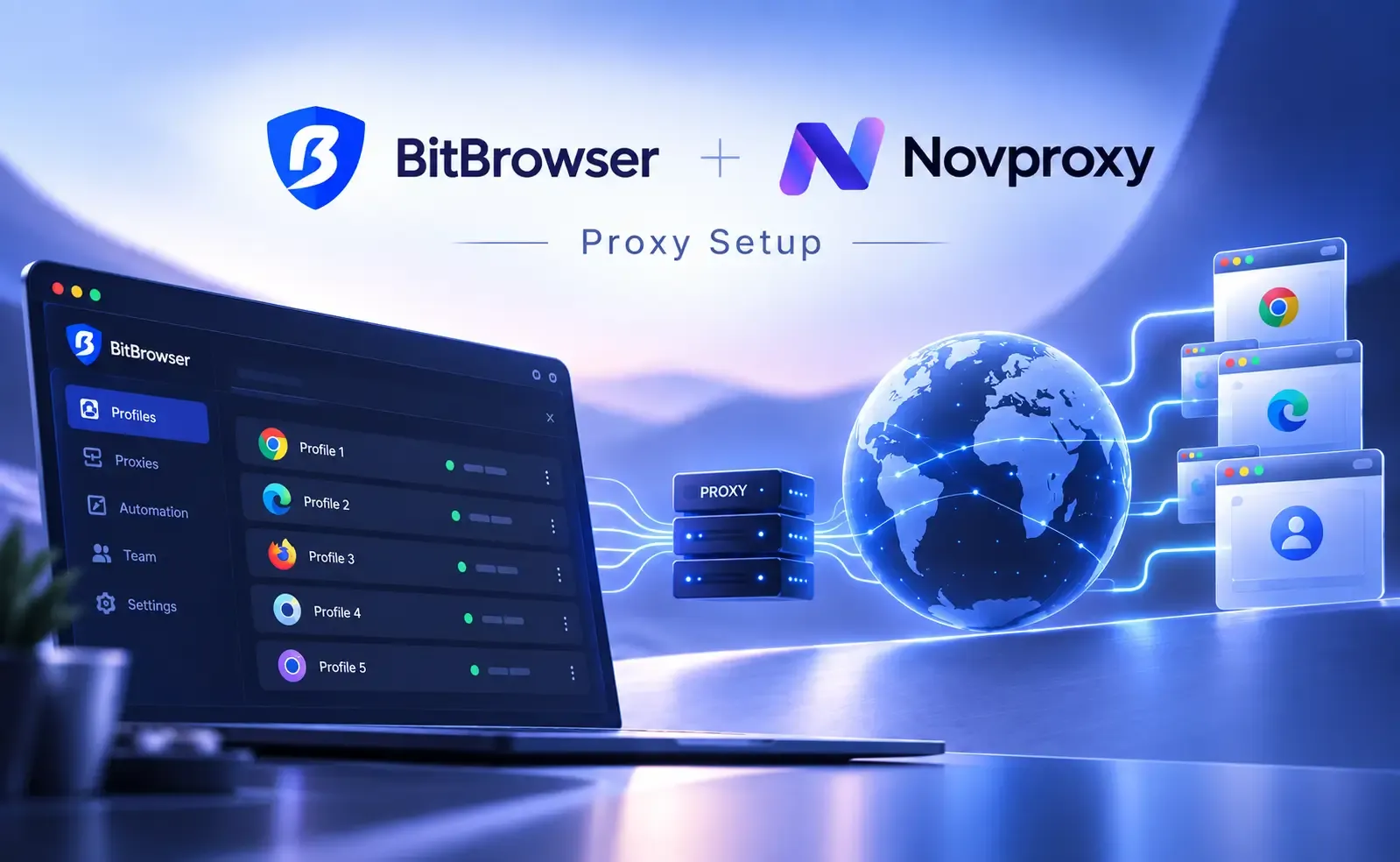
As multi-account work expands across online stores, social media, and different markets, the challenge is not simply whether a proxy works. The more important question is whether each browser profile, login state, and network connection can remain clearly mapped over time. A consistent setup makes regional checks, troubleshooting, daily maintenance, and team handovers easier to manage. This guide uses BitBrowser and Novproxy to walk through the process from profile planning and proxy selection to pre-login checks.
Reliable multi-account operations depend on clear, repeatable configuration. This guide shows how to pair BitBrowser profiles with Novproxy connections, choose a proxy type for each task, verify the setup before login, and document changes for ongoing maintenance.
1. Why Browser Profiles and Proxies Should Be Planned Together
Tabs in a standard browser usually share cookies, local storage, and other browser data. As the number of accounts grows, switching between them in one browser session makes it harder to keep login states separate and diagnose problems. Changing the network alone does not organise browser data. Creating multiple profiles without documenting their network settings creates a different maintenance problem.
BitBrowser is an anti-detect browser that lets users create separate browser profiles, retain cookies and login state for each profile, configure environment settings, and assign a proxy at the profile level. Its practical role is to keep account data and configuration organised. It does not replace platform verification or guarantee that an account will never be restricted.
Novproxy offers dynamic residential proxies, long-term static ISP connections, unlimited-traffic plans, and short-term residential IPs. The two products address different layers of the workflow: BitBrowser manages the browser profile and its stored session data, while Novproxy provides the network connection assigned to that profile.
2. Choosing a Novproxy Plan for the Task
| Use Case | Suggested Option | Why It Fits | What to Check |
|---|---|---|---|
| Ongoing store or social account management | Long-term static ISP | A persistent IP supports a consistent day-to-day connection | Choose a region relevant to the real business and avoid unnecessary region changes |
| Market research and regional page checks | Dynamic residential | Regional targeting and rotating or sticky sessions suit short research tasks | Match session duration to the task and do not use rapid rotation for long-lived logins |
| Compliant high-volume public data work | Unlimited bandwidth or port plan | The billing model may suit sustained traffic or multiple connections | Confirm concurrency, bandwidth, and the target site's rules before launch |
| Short tests and one-off verification | Short-term residential | Useful when the connection is needed only for a limited task | Avoid using a short-lived connection for an account that needs session continuity |
Plan names, available regions, session limits, and pricing can change. Confirm the current specification in the Novproxy dashboard before purchasing.
3. Setting Up BitBrowser with Novproxy
1. Create an Account Resource Map
For every authorised account, record the business name, market, BitBrowser profile name, proxy type, proxy region, owner, and latest review date. A consistent naming pattern such as platform, region, purpose, and number makes profiles easier to find and hand over.
2. Collect the Novproxy Connection Details
Choose the plan that matches the task and obtain the host, port, username, and password. Persistent account work generally prioritises connection continuity. Regional content checks usually prioritise location coverage and session controls. Review protocol support, location, session length, traffic, and concurrency before comparing price.
3. Create a Separate BitBrowser Profile
Create one profile for each account that needs its own stored session. Configure the operating system, browser version, language, timezone, and related settings according to the real business context. There is no benefit in changing every fingerprint option simply to make the profile look more complicated.
4. Assign the Novproxy Connection
Select the correct proxy protocol in the proxy settings, then enter the Novproxy host, port, and authentication credentials. For ongoing work, keep the profile-to-proxy mapping stable and document any change. Teams should also use permissions so that proxy settings are not edited without an audit trail.
5. Run Pre-Login Checks
Open the profile and confirm that the proxy connects. Check the public IP and IP reputation, detected region, timezone, and language against the intended setup. If the results do not match, troubleshoot the protocol, authentication, or profile settings before repeatedly testing with a live business account.
6. Save a Baseline
Record the profile name, proxy assignment, test date, and owner after the first successful check. If a login problem, regional content mismatch, or slow connection appears later, compare the current configuration with this baseline before making further changes.
4. Common Configuration Mistakes
Reusing One Proxy Across Unrelated Profiles
Whether a connection can be shared depends on the business relationship and platform rules. For unrelated accounts that require separate maintenance, reuse makes troubleshooting and ownership less clear. Keep a dedicated mapping for long-term accounts, and document any justified sharing.
Using a Region Unrelated to the Business
A connection from an unrelated region can change language, timezone, availability, and regional content. Choose locations that support the actual business requirement instead of switching countries without a documented reason.
Using Rapid Rotation for a Long-Lived Session
Rotating residential proxies are useful for regional checks and short research tasks. They are a poor fit for browser profiles that need a persistent login. Use a static connection or an appropriately long sticky session when continuity matters.
Changing Too Many Profile Settings
Start with the operating system, browser version, language, timezone, and proxy region. Adjust other settings only when the use case requires them. The more parameters a team changes, the more carefully it must document and reproduce the profile.
Logging In Before Testing the Connection
Authentication errors, incorrect regional detection, and timeouts should be found before account login. A standard pre-login check is easier to troubleshoot than repeated refreshes and frequent proxy changes after a problem appears.
Treating Tools as a Substitute for Platform Verification
BitBrowser and a proxy can organise profiles, sessions, and network settings. They cannot replace identity checks or guarantee account status. When a platform requests verification or limits an account, follow its official recovery and review process.
5. Ongoing Maintenance Checklist
- · Confirm that each account still maps to the correct BitBrowser profile and proxy configuration
- · Test connectivity and confirm that the public IP and detected region match the business requirement
- · Check that language, timezone, and operating system settings have not changed unexpectedly
- · Verify that cookies, login state, and required extensions remain in the correct profile
- · Review team permissions and document any profile or proxy change
- · Check for updates to platform terms and the proxy plan specification
6. Conclusion
BitBrowser and Novproxy solve two practical parts of multi-account work: separating stored browser sessions and assigning a documented network connection to each profile. Build the account-to-profile-to-proxy map first, choose the connection type according to the task, and make pre-login checks and change records part of routine operations. A stable, auditable workflow is easier to maintain than frequent environment changes.

 Multi-Account Management
 Prevent Account Association
 Multi-Employee Management