Wi-Fi 6 vs Wi-Fi 5 in 2026: Key Differences, Speed, Security, and FeaturesWi-Fi 6 vs Wi-Fi 5 in 2026: Key Differences, Speed, Security, and Features
 2026.01.24 06:55
 petro
petroWireless technology evolves rapidly, with new Wi-Fi standards emerging roughly every five years. After Wi-Fi 5 (802.11ac), Wi-Fi 6 (802.11ax) was introduced, followed by an enhanced version, Wi-Fi 6E. Wi-Fi 7 is expected next. In this article, we’ll focus on comparing Wi-Fi 6 and Wi-Fi 5, highlighting their key differences.

Wi-Fi Standards Timeline
| Standard | IEEE Name | Year |
|---|---|---|
| Wi-Fi 1 | 802.11b | 1999 |
| Wi-Fi 2 | 802.11a | 1999 |
| Wi-Fi 3 | 802.11g | 2003 |
| Wi-Fi 4 | 802.11n | 2009 |
| Wi-Fi 5 | 802.11ac | 2014 |
| Wi-Fi 6 | 802.11ax | 2019 |
| Wi-Fi 6E | 802.11ax | 2021 |
| Wi-Fi 7 | 802.11be | 2024 |
These names and shorthand formats are defined by the Wi-Fi Alliance.
1. Standard Names
Each Wi-Fi evolution introduces a new IEEE standard. Wi-Fi 5 is 802.11ac, while Wi-Fi 6 is 802.11ax.
2. Frequency Bands
Wi-Fi 5 operates only on the 5 GHz band, whereas Wi-Fi 6 supports both 2.4 GHz and 5 GHz bands. Wi-Fi 6E further adds the 6 GHz band, providing more spectrum and reducing congestion
3. Data Transfer Speeds
Speed is a major differentiator. Wi-Fi 5 achieves a maximum theoretical rate of 6.9 Gbps, while Wi-Fi 6 reaches 9.6 Gbps.
Wi-Fi 5 uses 256-QAM modulation, whereas Wi-Fi 6 employs 1024-QAM, allowing more efficient and faster data transmission. Wi-Fi 6 also improves spectrum utilization, resulting in approximately 40% faster speeds even in real-world scenarios.
4. Approaching Wired Speeds
Although wired networks are still faster, Wi-Fi 6 brings wireless speeds closer to wired performance. Increasing traffic from gaming, AR/VR, and live streaming requires higher bandwidth, and Wi-Fi 6 helps meet these demands, encouraging more users to rely on wireless networks both at home and in businesses.
5. Battery Efficiency
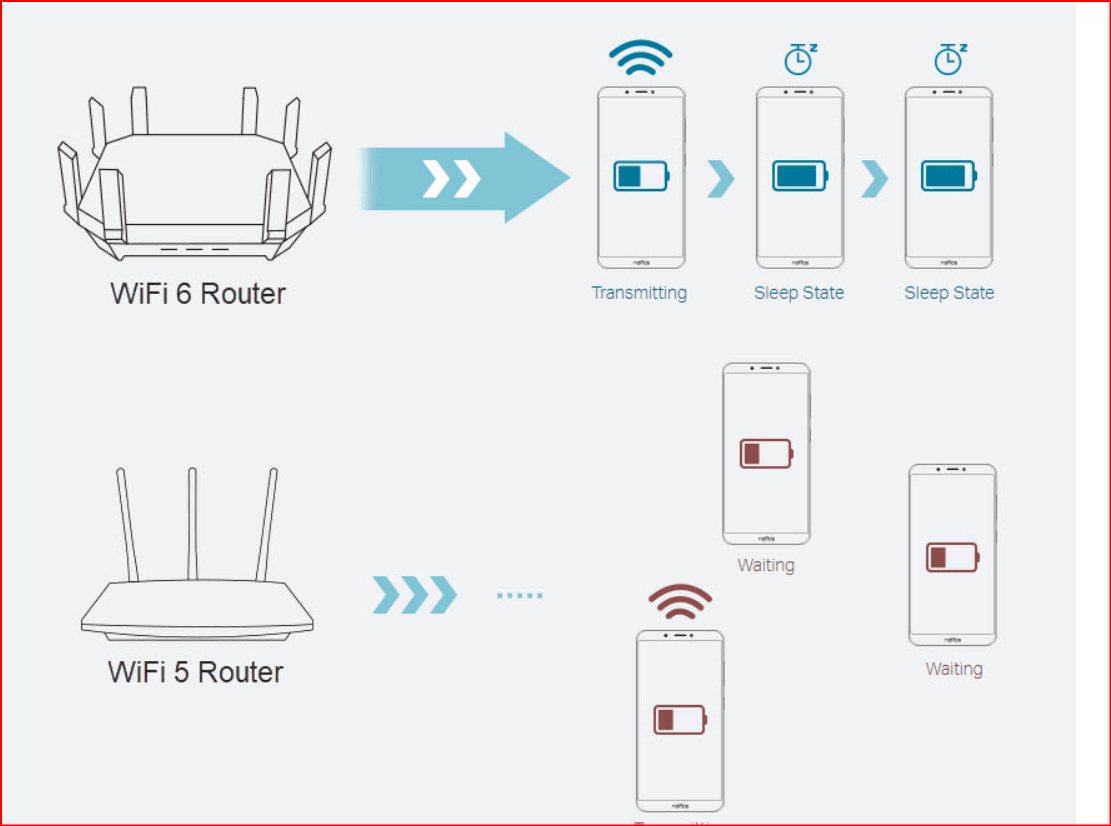
New features can increase power consumption, but Wi-Fi 6 introduces Target Wake Time (TWT). TWT allows access points to schedule communication with devices, letting them enter low-power mode when idle, which extends battery life for smartphones, laptops, and IoT devices
6. OFDMA vs OFDM
Wi-Fi 5 uses OFDM (Orthogonal Frequency-Division Multiplexing), which allows only one user to transmit at a time. Wi-Fi 6 adopts OFDMA (Orthogonal Frequency-Division Multiple Access), combining TDMA and FDMA. This enables multiple devices to transmit simultaneously, improving efficiency in busy networks.
7. Security Protocols
Wi-Fi 5 supports WPA and WPA2, while Wi-Fi 6 adds WPA3, providing stronger encryption and protection against modern threats. WPA3 addresses vulnerabilities found in WPA2 and enhances security for sensitive applications.
8. Beamforming
Wi-Fi 6 improves beamforming, a feature that directs signals toward specific devices rather than broadcasting them indiscriminately. This results in better coverage and performance
9. BSS Coloring
A new Wi-Fi 6 feature, BSS Coloring, identifies overlapping Basic Service Sets (BSS) and reduces interference in crowded environments. Combined with OFDMA, it ensures efficient connectivity in high-density areas.
10. Antennas and MU-MIMO
Wi-Fi 5 supports 4x4 MU-MIMO in downlink only, allowing four simultaneous device connections. Wi-Fi 6 expands this to 8x8 MU-MIMO, supporting up to eight devices and enabling bidirectional communication. This is particularly useful in offices, stadiums, or crowded homes.
Conclusion
Wi-Fi 6 introduces numerous improvements over Wi-Fi 5, including:
Faster speeds and higher data efficiency
Support for more devices simultaneously
Extended battery life for connected devices
Enhanced security with WPA3
Better performance in crowded networks with BSS Coloring and OFDMA
For anyone upgrading their network or planning new deployments, understanding these differences helps make informed decisions. Wi-Fi 6 is clearly designed for higher efficiency, scalability, and future-proof wireless connectivity.