4G vs 5G Mobile Proxies: Speed, Latency & Real Performance (2026)
 2026.02.20 09:14
 petro
petroWith 5G networks expanding globally, many users wonder whether 5G mobile proxies offer meaningful advantages over 4G LTE. While the marketing around 5G promises ultra-fast speeds and ultra-low latency, the real question is: does it matter for proxy use cases?
This technical analysis compares 4G LTE and 5G mobile proxies using real benchmark data to help you make an informed decision.
Quick Performance Comparison
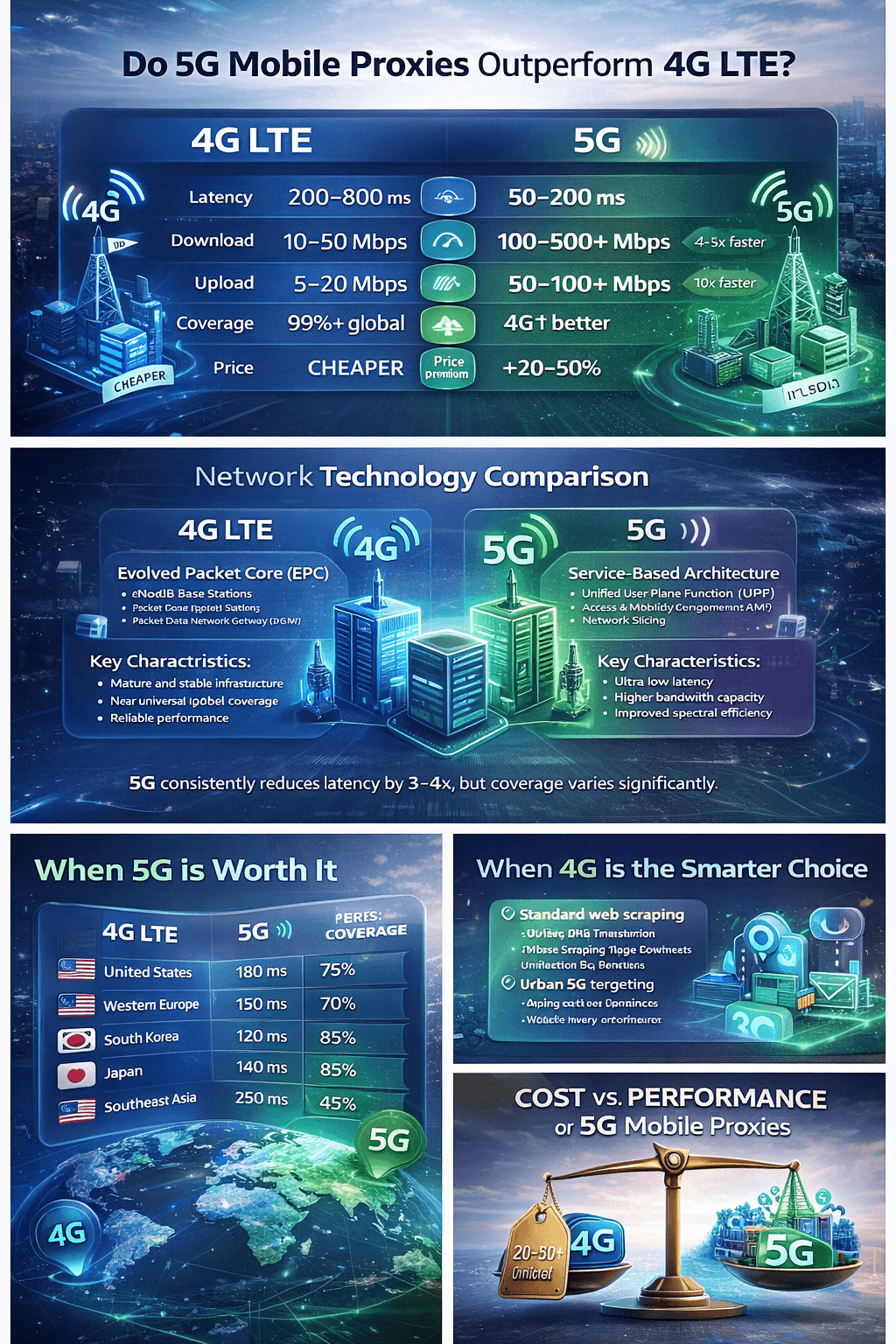
| Metric | 4G LTE | 5G | Improvement |
|---|---|---|---|
| Latency | 200–800 ms | 50–200 ms | 4–5x faster |
| Download Speed | 10–50 Mbps | 100–500+ Mbps | 10x faster |
| Upload Speed | 5–20 Mbps | 50–100+ Mbps | 5x faster |
| Coverage | 99%+ global | 60–70% (urban) | 4G better |
| Price Premium | Base price | +20–50% | 4G cheaper |
Network Technology Deep-Dive
4G LTE Technology
4G LTE (Long-Term Evolution) is built on the Evolved Packet Core (EPC) architecture, which includes:
eNodeB base stations
Mobility Management Entity (MME)
Packet Data Network Gateway (PGW)
Key Characteristics:
Mature and stable infrastructure
Near-universal global coverage
Well-established CGNAT implementation
Predictable, consistent performance
4G has been optimized for over a decade, making it highly reliable for proxy operations worldwide.
5G Technology
5G introduces a service-based architecture, featuring:
Access and Mobility Management Function (AMF)
User Plane Function (UPF)
Network slicing
Key Characteristics:
Ultra-low latency design
Higher bandwidth capacity
Improved spectral efficiency
Flexible, scalable network infrastructure
5G was engineered to support next-generation applications like autonomous systems and real-time communication.
Real-World Latency Benchmarks (2026 Data)
Latency by Geographic Region
| Region | 4G Avg. | 5G Avg. | 5G Coverage |
|---|---|---|---|
| United States | 180 ms | 65 ms | 75% |
| Western Europe | 150 ms | 55 ms | 70% |
| South Korea | 120 ms | 40 ms | 95% |
| Japan | 140 ms | 50 ms | 85% |
| Southeast Asia | 250 ms | 90 ms | 45% |
Observation: 5G consistently reduces latency by 3–4x, but coverage varies significantly.
Cost-Benefit Analysis
5G mobile proxies typically cost 20–50% more than 4G equivalents.
The key question is whether the performance gain justifies the additional expense for your specific workload.
When 5G Is Worth the Premium
✔ Latency-sensitive operations
Real-time bidding (RTB)
Automated trading
Live monitoring systems
✔ High-bandwidth tasks
Video scraping
Large dataset downloads
Media-heavy automation
✔ Urban-focused targeting
Campaigns centered in cities with strong 5G infrastructure
✔ Future-proofing
Building systems optimized for upcoming network standards
When 4G Is the Smarter Choice
✔ Standard web scraping
200 ms vs 50 ms rarely impacts results
✔ Budget-conscious operations
More IP coverage per dollar spent
✔ Global campaigns
4G works nearly everywhere
✔ Social media automation
Website rate limits are the bottleneck—not network speed
Reality Check
For 90% of proxy use cases, the latency difference between 4G and 5G is barely noticeable.
Example:
4G request: 200 ms
5G request: 50 ms
Target website response time: 500–1000 ms
In most cases, the website itself is slower than the network. The true bottleneck is often:
Server response time
Anti-bot protections
Rate limiting
CAPTCHA challenges
Network speed is rarely the limiting factor.
5G Coverage Availability (2026)
Strong 5G Coverage (70%+)
?? South Korea — 95%
?? Japan — 85%
?? United States (urban) — 75%
?? Western Europe — 70%
Limited 5G Coverage (<50%)
Southeast Asia — 45%
Latin America — 35%
Eastern Europe — 40%
Africa — 15%
Important: 5G is heavily concentrated in urban areas. Rural and suburban regions often fall back to 4G automatically.
Always consider your target geography before choosing.
Decision Framework
Is sub-100 ms latency critical?
Yes → Consider 5G
No → 4G is sufficient
Are your targets in urban 5G areas?
Yes → 5G is viable
No → 4G is more reliable
Does the 20–50% price premium fit your budget?
Yes → 5G may be worthwhile
No → 4G delivers 95% of the value
Is bandwidth your main constraint?
Yes → 5G shines
No → 4G is enough
Final Verdict
4G remains the best default choice for most proxy users due to:
Near-global coverage
Lower cost
Stable infrastructure
Minimal real-world performance difference
5G makes sense only when:
Latency is mission-critical
Your operation is urban-focused
Bandwidth demands are extremely high
Try Both 4G and 5G Mobile Proxies
The smartest approach is often hybrid:
Start with 4G for most operations
Upgrade to 5G for latency-sensitive tasks
Use both depending on geography
Unlimited bandwidth plans allow flexibility without overcommitting.
Managing 4G & 5G Proxies with BitBrowser Roles
When running mobile proxies at scale — especially mixing 4G and 5G endpoints — proper team access control becomes critical.
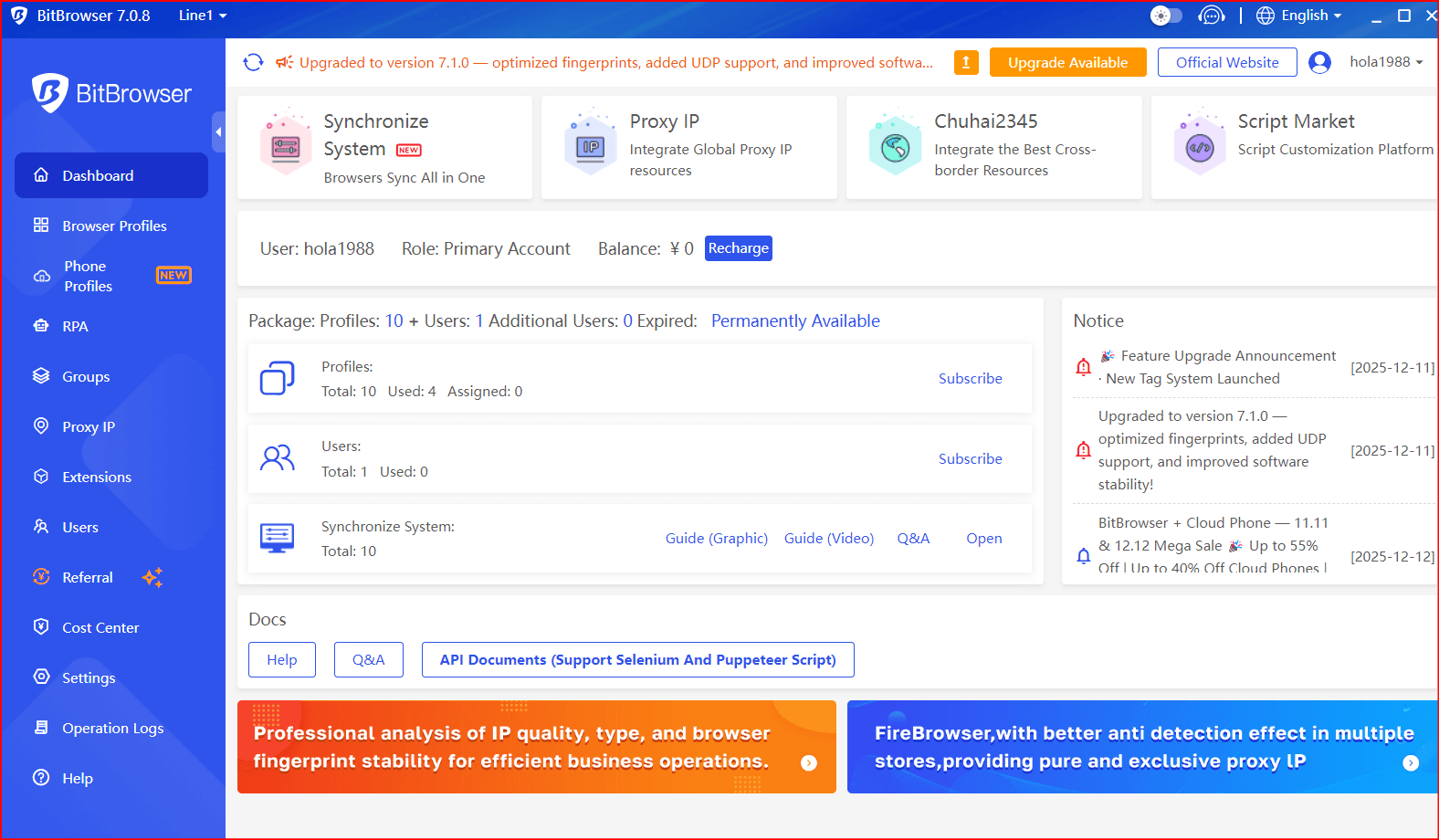
BitBrowser allows you to assign custom roles to control how team members interact with proxy configurations and browser profiles.
Why Roles Matter for Mobile Proxy Operations
If you're operating:
Multiple 4G and 5G proxy pools
Different geographic targeting setups
High-value automation campaigns
Shared infrastructure across team members
You don’t want every user having full access to modify proxies.
Role management protects:
Proxy credentials
IP rotation settings
Fingerprint configurations
API integrations
Recommended Role Structure for Proxy Teams
Admin
Full system access.
Permissions:
Add/remove proxies (4G & 5G)
Modify fingerprint settings
Manage team members
Export/import profiles
API access
Best for: Infrastructure owners
Proxy Manager
Proxy-focused access without team control.
Permissions:
Add/edit/delete proxies
Assign proxies to profiles
Monitor connection performance
View bandwidth usage
Best for: Technical operators managing mobile IP pools
Automation Operator
Limited operational access.
Permissions:
Use existing profiles
Launch sessions
Switch between 4G/5G assigned profiles
No access to proxy credentials
Best for: Campaign managers or account operators
Viewer (Read-Only)
Monitoring only.
Permissions:
View profiles
View proxy status
No modification rights
Best for: Clients or supervisors
Best Practice: Separate 4G & 5G Access
If you are testing performance differences between 4G and 5G:
Create dedicated profile groups (4G Group / 5G Group)
Assign different proxy managers per group
Restrict switching permissions to avoid configuration errors
This prevents accidental mixing of latency-sensitive and standard workloads.
Security Tip
Because 5G proxies are typically more expensive (20–50% premium), restrict editing rights to avoid:
Unnecessary bandwidth usage
Wrong geo assignments
Misconfigured rotations
Proper role separation reduces operational risk

 Multi-Account Management
 Prevent Account Association
 Multi-Employee Management
Recommended
See More