Henry Duy Releases Meta Ads Research for the Proxy Industry
 2026.11.17 05:56
 BitBrowser
The growing competition in the global proxy market has made customer acquisition increasingly challenging for service providers. Companies offering residential, datacenter, ISP, and mobile proxies must compete for customer attention while managing advertising costs, conversion rates, and subscription profitability. However, the lack of dedicated advertising benchmarks for the proxy industry makes it difficult for businesses to determine whether their campaigns are performing efficiently.
Addressing this challenge, Henry Duy, Founder of GDT Group and CEO of GDT Agency, has developed an in-depth research report examining Meta Ads performance in the proxy industry. The research combines publicly available advertising benchmarks with a 12-month campaign dataset to evaluate advertising costs, audience engagement, conversion performance, and customer acquisition economics.
With nearly 10 years of experience in digital advertising and performance marketing, Henry Duy approaches the research from a practical advertising perspective. His analysis examines not only how campaigns generate impressions and clicks but also how advertising expenditure translates into registrations, trial activations, and paying customers.
The Meta Ads Benchmark: What Published Industry Data Reveals
Before evaluating proxy advertising performance, Henry's research establishes a reference point using publicly reported Meta Ads benchmarks.
The analysis considers WordStream and LocaliQ's 2025 advertising benchmark report, which covers campaigns in the United States between April 2024 and June 2025.
The published data provides a comparison across three major campaign objectives: traffic, lead generation, and ecommerce sales.
Meta Ads Performance Across Different Campaign Objectives
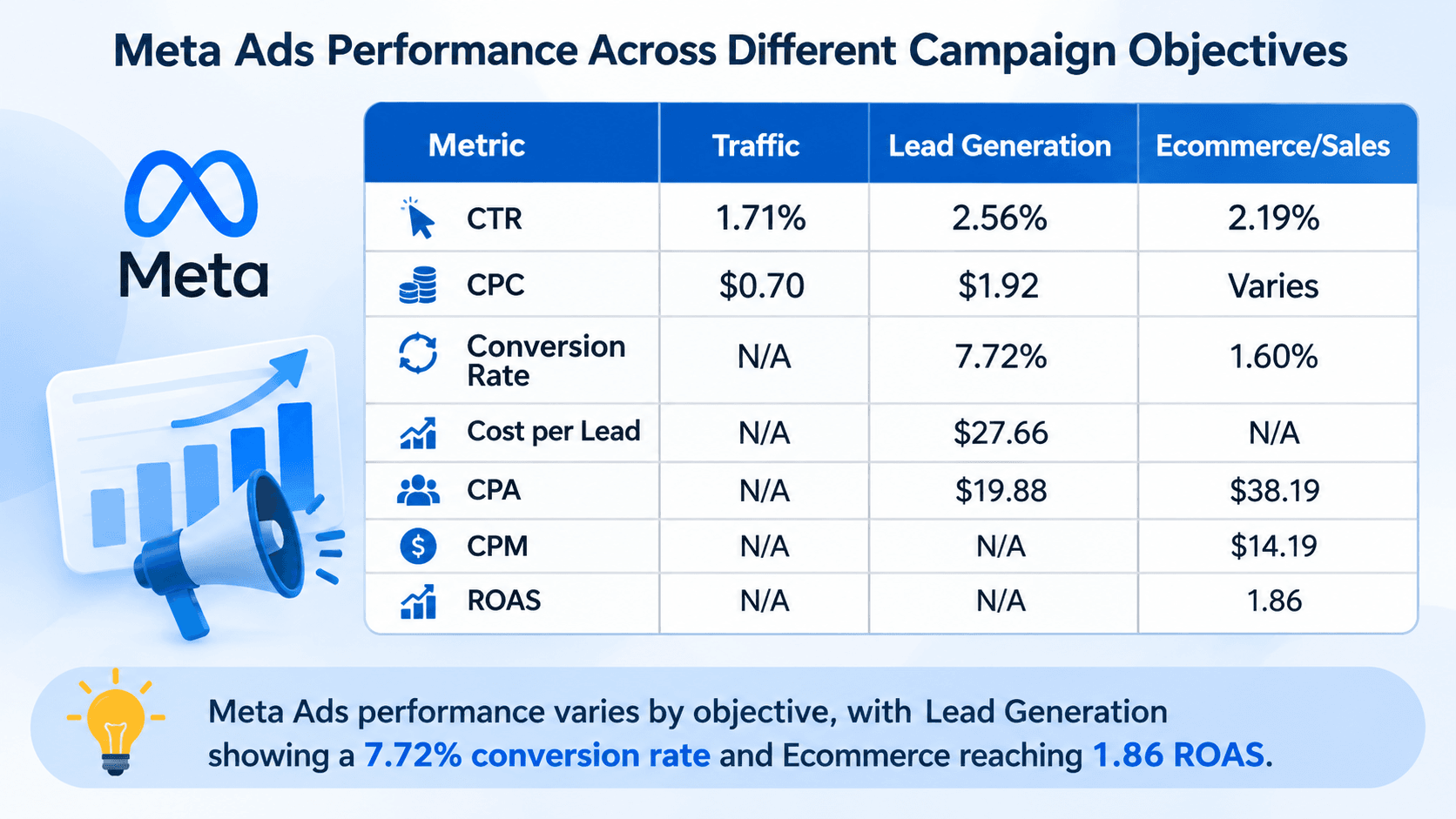 The figures reveal meaningful differences between advertising objectives.
Traffic campaigns recorded an average CTR of 1.71%, while lead generation campaigns achieved 2.59%. Ecommerce campaigns recorded a 2.19% CTR and a 1.60% purchase conversion rate.
Henry identifies an important distinction in interpreting these figures. Meta optimizes campaigns according to their selected objectives, so traffic campaigns and conversion campaigns can attract users with different behavioral patterns.
Advertisers should therefore evaluate each campaign against the benchmark that matches its intended conversion event.
Technology/SaaS and B2B as Reference Industries
Proxy services share several characteristics with technology and subscription-based businesses. Customers often evaluate technical specifications, pricing structures, service reliability, and product suitability before purchasing.
For this reason, Technology/SaaS and B2B provide more relevant comparison points than traditional consumer e-commerce.
The industry comparison used in Henry's research includes the following figures:
Technology/SaaS recorded a 1.04% CTR, a 2.31% conversion rate, and a $55.21 CPA in the benchmark dataset.
Henry considers these figures useful reference points because proxy businesses frequently operate through recurring subscriptions and technology-focused customer acquisition.
However, he also emphasizes that the benchmark CPA must be interpreted according to its underlying conversion event. A cost per lead, registration, or purchase cannot automatically be compared with the cost of acquiring a paying subscription customer.
The Importance of Placement Performance
Meta advertising placements can influence campaign costs and conversion quality.
Henry's analysis uses the following indicative operational ranges to examine placement performance:
These figures represent operational reference ranges rather than official Meta industry averages.
Henry's analysis highlights why advertisers should evaluate placement performance through downstream conversions. A placement that generates inexpensive clicks may still produce poor customer acquisition results if visitors do not register, activate trials, or purchase subscriptions.
A 12-Month Analysis of Meta Ads Performance in the Proxy Industry
During the implementation and optimization of Meta advertising campaigns, Henry Duy focuses on analyzing performance at each stage of the customer conversion journey. Given the specific characteristics of the proxy industry, his analysis considers key factors such as traffic acquisition costs, account registration rates, free trial activation rates, and the conversion of trial users into paying customers.
Based on Henry Duy's actual Meta Ads campaign results over a 12-month period, the analysis examines advertising costs, conversion volumes, lead quality, and revenue. These results illustrate the relationship between advertising budgets, conversion performance, and business outcomes, providing practical insights that proxy businesses can use when evaluating and optimizing their Meta Ads campaigns.
Overall Advertising Performance
The dataset establishes the following performance indicators:
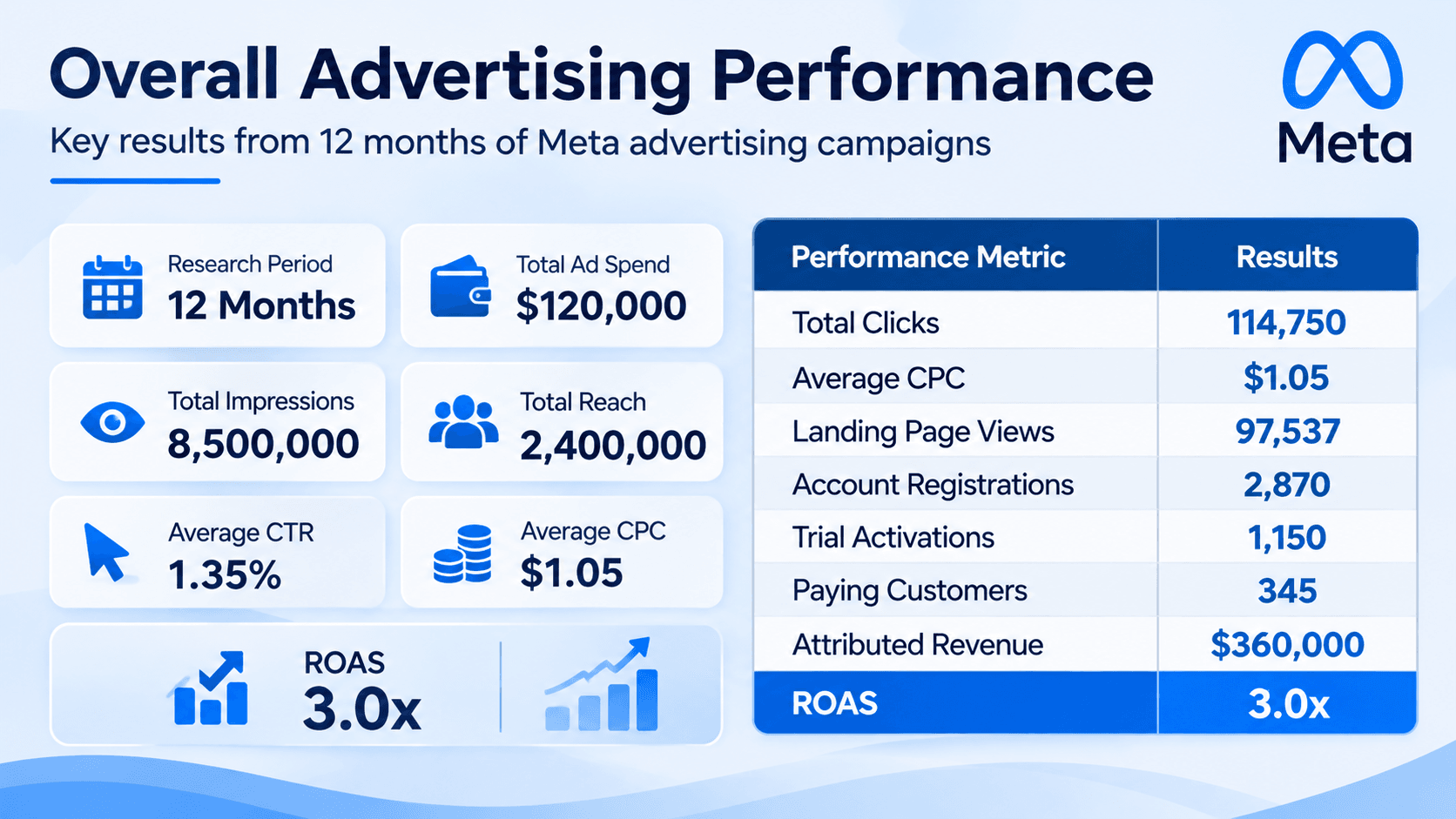
The results provide a consistent basis for examining the relationship between advertising expenditure and customer acquisition.
An average CTR of 1.35% indicates that the campaigns generate engagement above the 1.04% Technology/SaaS reference figure. The CPC of $1.05 also indicates relatively efficient click acquisition compared with the $1.92 lead campaign reference.
The ROAS reaches 3.0x, placing it within the supplied Technology/SaaS reference range of 2.8-4.2x.
These comparisons offer an illustration of how proxy advertising performance can be evaluated against broader technology industry benchmarks.
Conversion Funnel Analysis
Advertising performance does not end when users click an advertisement. Proxy providers must also understand how effectively their websites convert visitors into registered accounts, trial users, and paying customers.
The conversion funnel produces the following results:
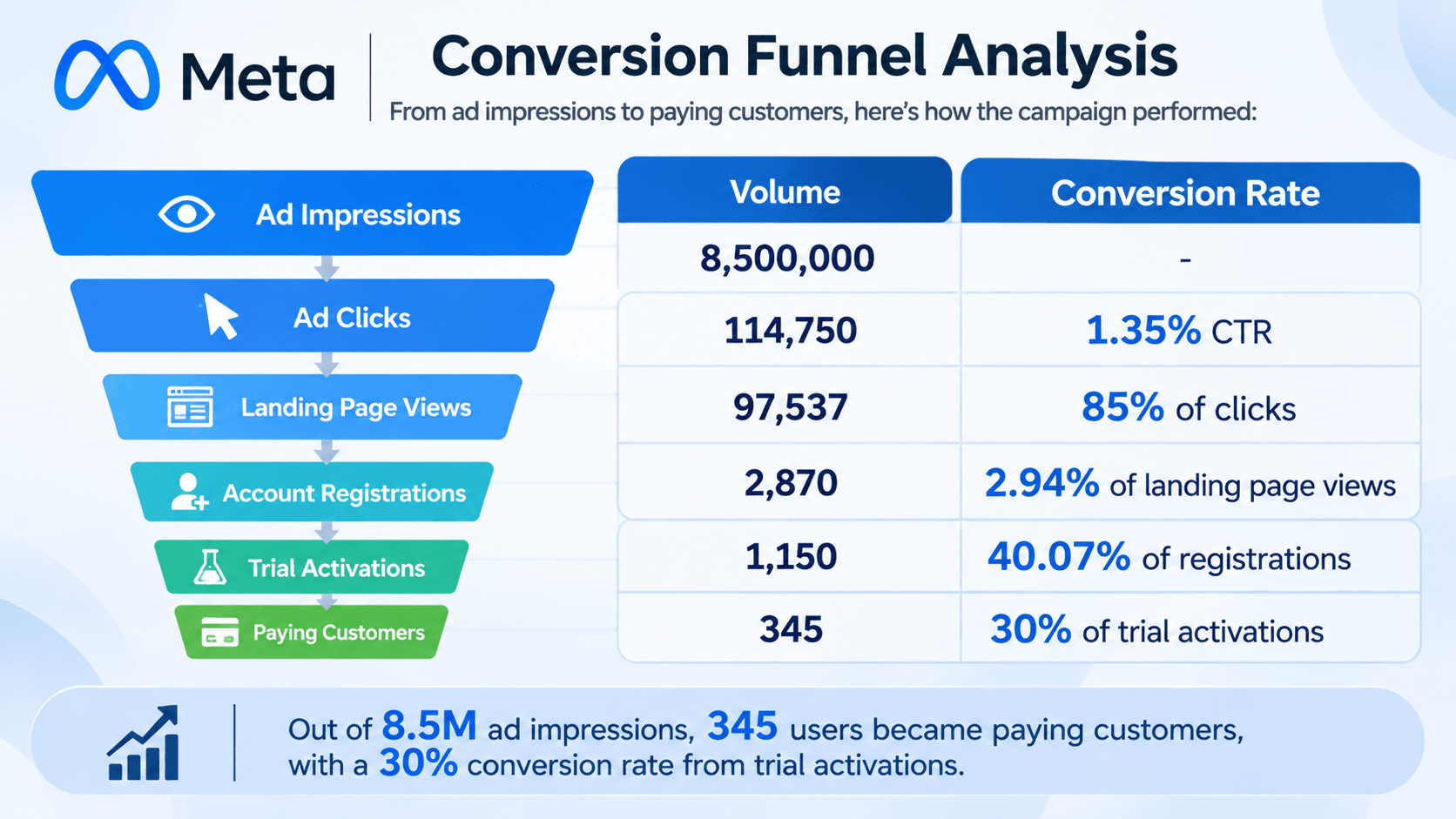
The funnel identifies 3 important conversion stages.
- First, the landing page receives approximately 85% of recorded ad clicks. This indicates that there is some traffic loss between the initial click and the website visit.
- Second, 2.94% of landing page visitors complete account registration. This makes registration performance an important indicator of landing page effectiveness and offer relevance.
- Third, 30% of trial activations convert into paying customers. This final stage demonstrates why proxy providers must evaluate product activation, onboarding, and subscription conversion alongside advertising metrics.
Customer Acquisition Costs
The relationship between advertising expenditure and conversion volume provides another important measurement perspective.
Using the total advertising investment of $120,000, the research calculates the following blended acquisition costs:
These figures use the full advertising investment as the numerator for each conversion event. They represent blended funnel acquisition costs, not independently attributed costs for individual campaign objectives.
The difference between registration cost and paying customer acquisition cost illustrates the financial impact of conversion losses throughout the funnel.
Henry's analysis highlights an important consideration for proxy providers: inexpensive registrations do not necessarily produce profitable customers.
Businesses must examine the entire conversion journey to determine whether their advertising investments generate customers with sufficient subscription value and retention potential.
Revenue and Advertising Return
The dataset also includes $360,000 in attributed revenue against $120,000 in advertising expenditure.
This produces a return on ad spend of 3.0x.
The result falls within the supplied Technology/SaaS ROAS reference range of 2.8-4.2x.
However, ROAS alone does not establish profitability. Proxy providers must also consider service delivery costs, payment processing, infrastructure expenses, customer support, refunds, and subscription churn.
Henry's research therefore treats ROAS as one part of a wider customer acquisition and business performance framework.
Comparing Proxy Advertising Performance With Published Industry Benchmarks
The next stage of the research compares the proxy campaign results with published industry figures.
This comparison helps identify where the performance stands relative to broader advertising benchmarks.
The comparison reveals several observations.
- CTR performance: The proxy campaigns achieve a 1.35% CTR, approximately 29.8% above the Technology/SaaS reference of 1.04%.
- CPC performance: The CPC of $1.05 is approximately 45.3% below the $1.92 lead campaign reference. This is a directional comparison because the two figures represent different campaign objectives.
- CPM performance: The CPM of $14.12 is close to the $14.19 ecommerce reference. This suggests that the advertising costs remain within a similar range.
- Conversion performance: The registration rate reaches 2.94%, compared with the 2.31% Technology/SaaS reference. This comparison is indicative because the conversion definitions and measurement methods may differ.
- CPA performance: The cost per paying customer reaches $347.83. This figure should not be directly compared with the $55.21 Technology/SaaS CPA because the conversion events may represent different stages of the customer journey.
- ROAS performance: The 3.0x ROAS falls within the supplied Technology/SaaS reference range.
Henry's analysis demonstrates that meaningful benchmark comparisons require consistent conversion definitions, attribution windows, and measurement methods. Without these controls, apparently favorable advertising metrics can produce misleading conclusions.
Henry Duy's Advertising Strategy: From Data Analysis to Campaign Optimization
The research framework also identifies several areas that influence Meta Ads performance in the proxy industry.
Henry's approach focuses on connecting advertising decisions with measurable customer acquisition outcomes.
Audience Research and Customer Segmentation
Proxy providers serve different customer groups, and each group has distinct purchasing requirements.
Individual users may prioritize affordable pricing and ease of use. Developers may focus on API integration, connection stability, and technical documentation. E-commerce operators and data collection teams may require larger IP pools, geographic coverage, and scalable infrastructure.
Henry's framework separates these audiences instead of treating all proxy customers as one advertising segment.
This segmentation allows advertisers to align campaign messaging, landing pages, and offers with the specific requirements of each customer group.
Creative Testing and Optimization
Advertising creative influences whether users notice an advertisement and decide to visit a website.
For proxy products, effective creative should communicate relevant product benefits, such as IP coverage, connection reliability, proxy types, technical capabilities, and pricing structures.
Henry's framework evaluates creative performance through CTR, CPM, CPC, and conversion outcomes.
Rather than selecting advertisements based solely on engagement, the framework prioritizes creative that attracts users who are more likely to register and purchase.
Campaign Structure and Budget Allocation
The research divides the $120,000 annual advertising investment into four campaign categories:
This structure illustrates how advertisers can distribute spending across different stages of customer acquisition.
Traffic campaigns introduce potential customers to the product. Registration campaigns encourage account creation. Trial campaigns support product evaluation, while purchase-oriented campaigns target users who demonstrate stronger buying intent.
The allocation represents a proposed plan rather than an independently measured optimal budget distribution.
Landing Page and Conversion Funnel Optimization
Advertising performance depends on what happens after users reach a website.
A proxy provider may generate substantial traffic but still struggle to acquire customers if its landing page does not communicate product differences, pricing, technical specifications, or subscription benefits effectively.
Henry's framework examines landing page view rates, registration rates, trial activation rates, and trial-to-paid conversion rates.
These indicators help advertisers identify where potential customers leave the purchase journey.
For example, a high registration volume combined with a low trial activation rate may indicate onboarding difficulties rather than an advertising creative problem.
Pixel Tracking and Conversion Measurement
Reliable measurement provides the foundation for campaign optimization.
Proxy providers need to distinguish between initial website visits, account registrations, trial activations, checkout events, and completed purchases.
Meta Pixel and, where appropriate, Conversions API can support event tracking and help advertisers improve conversion measurement.
Henry's framework emphasizes the importance of accurate event definitions, consistent attribution settings, and reliable reporting.
Without these elements, advertisers may optimize campaigns toward low-value actions while overlooking the actual cost of acquiring paying customers.
Retargeting and Customer Acquisition Optimization
Potential proxy customers may require multiple interactions before making a purchase.
Retargeting can help businesses reconnect with users who visited product pages, created accounts, activated trials, or initiated checkout without completing a purchase.
The research framework separates these audiences according to their funnel positions.
This approach allows advertisers to present more relevant messages to potential customers and evaluate the additional contribution of retargeting to paid subscriptions.
Henry Duy's Professional Experience in Digital Advertising
Henry Duy's research reflects his professional focus on digital advertising, performance marketing, and advertising infrastructure.
With nearly 10 years of experience in online advertising, Henry has developed expertise across major advertising platforms, including Meta, Google, and TikTok.

As Founder of GDT Group and CEO of GDT Agency, he has focused on advertising operations, campaign infrastructure, budget management, and digital growth strategies for businesses operating across different markets.
His work covers several important aspects of performance advertising:
- Meta, Google, and TikTok advertising operations.
- Advertising account infrastructure and management.
- Campaign planning and budget allocation.
- Audience research and performance optimization.
- Conversion tracking and advertising measurement.
- Customer acquisition and performance analysis.
His research into the proxy industry reflects the importance of combining advertising knowledge with an understanding of specific business models.
Rather than evaluating campaigns through isolated metrics, Henry's analytical framework connects advertising performance with customer behavior, subscription conversion, and revenue generation.
As the proxy market continues to develop, this approach provides businesses with a more structured way to assess Meta Ads performance and make informed advertising decisions.
For Henry Duy, effective digital advertising is not simply about generating impressions or clicks. It is about understanding the relationship between advertising investment, customer acquisition, and long-term business value.

 Multi-Account Management
 Prevent Account Association
 Multi-Employee Management
Recommended
See More