How to Choose the Right Residential Proxy Provider for Your Web Scraping Needs
 2026.01.09 16:50
 YT.Shi
Choosing a residential proxy provider is one of the most important decisions you'll make as a web scraper or data collector. The wrong choice can mean wasted money, failed scraping jobs, and frustrated teams. The right choice? Seamless operations, high success rates, and reliable data.
But with dozens of providers claiming to be "the best," how do you actually decide?
The Core Problem
Most developers choose residential proxies based on price alone. They pick the cheapest option, deploy it, and then watch their scraping jobs fail spectacularly. Why? Because cheap providers cut corners on IP quality, don't rotate aggressively enough, and get blocked frequently.
On the flip side, premium providers can cost 3-5x more without delivering proportional value for smaller operations.
The key is matching the right provider to your specific use case.
What Actually Matters?
1. IP Pool Size and Diversity
A provider's IP pool is everything. Bright Data operates 175M+ residential IPs; smaller providers might have 5-10M. Larger pools mean better rotation options, less chance of getting blocked, and geographic flexibility.
But size isn't everything. A pool of 175M IPs concentrated in 50 countries is less useful than 50M IPs spread across 195 countries if you need global coverage.

2. Success Rate and Stability
Success rate matters more than you'd think. A provider claiming 99.9% uptime sounds great until you realize that 0.1% downtime means 1 in 1,000 requests fails. At scale, that's significant.
Real-world performance varies by target website. Some providers excel at scraping e-commerce sites but struggle with news sites or real estate portals.
This is why independent testing is critical.

3. Pricing Structure
Most residential proxy providers charge per GB of bandwidth. Pricing typically ranges from $0.77/GB (budget providers) to $4.20/GB (premium providers with premium support).
But watch out for:
● Hidden overage charges
● Minimum purchase requirements
● Data rollover policies (some expire unused data)
● Concurrent connection limits on cheaper plans
Transparent, straightforward pricing with no surprises is worth paying a bit extra for.
4. Ethical Sourcing
This matters more than many realize. Residential proxies come from real devices, and not all providers source them ethically. Some providers use stolen credentials or malware to collect IPs; others explicitly exclude users who haven't consented.
GDPR-compliant providers prove they've obtained IP addresses legally. It's worth verifying.

5. Customer Support
Web scraping is technical. When things break at 2 AM, you need support that understands your use case—not a chatbot reading scripts.
Look for providers offering:
●Email or live chat with technical expertise
●Response times under 24 hours
●Knowledge of common scraping frameworks and use cases
●Willingness to help diagnose blocking issues

How ProxyCorner Can Help Compare Residential Proxy Providers
Evaluating all these factors manually can be time-consuming. Fortunately, there are platforms that provide side-by-side comparisons of residential proxy providers based on real-world performance.
For example, ProxyCorner.com conducts independent testing of residential proxy providers using real-world scraping scenarios. Their evaluations cover IP quality, rotation speed, success rates across different target sites, and responsiveness of customer support. The reviews are designed to be impartial, as ProxyCorner does not have affiliate relationships with the providers, focusing on accurate performance data over commissions.
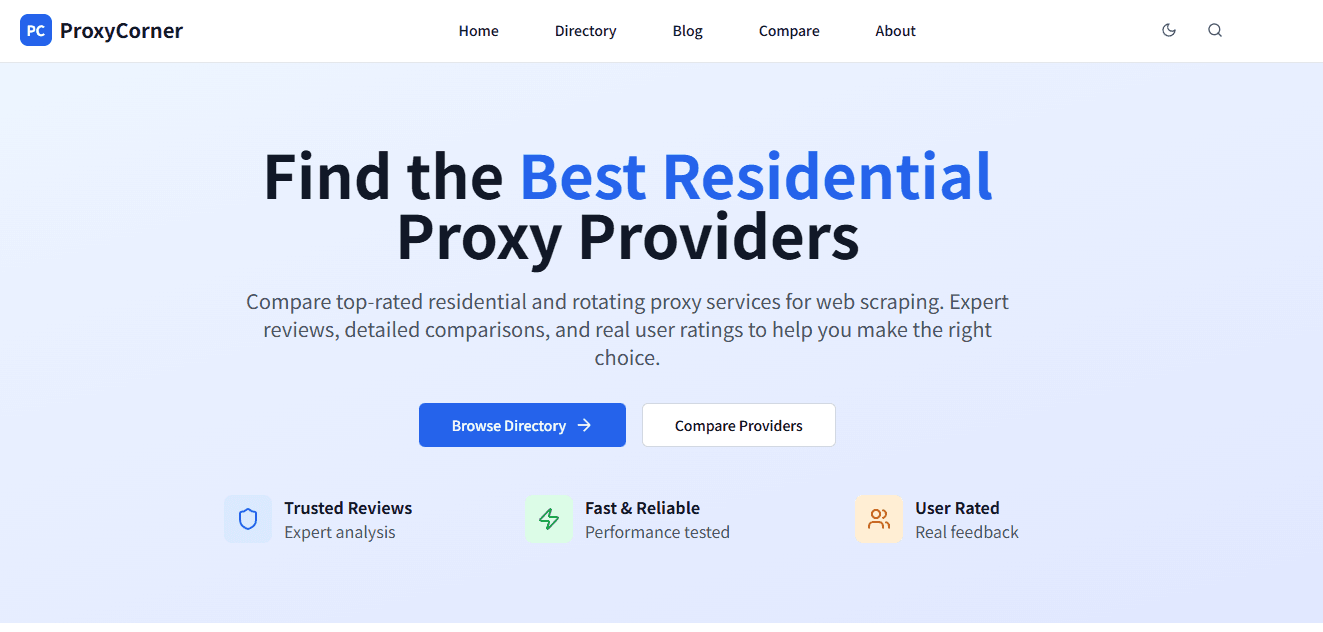
ProxyCorner offers resources such as::
● Compare top providers side-by-side with real performance data
● Filter by your specific needs (budget, geography, use case)
● Read authentic user reviews from verified customers
● Access detailed pricing breakdowns
● Find the best provider for e-commerce scraping, SEO data collection, real estate aggregation, or any other use case
Using such platforms can help you make informed decisions without relying solely on marketing claims.
The Bottom Line
Don't choose a residential proxy provider based on price or marketing claims alone. Focus on your actual needs, verified performance data, and transparent pricing.
For those who want to simplify the evaluation process, there are several platforms that provide side-by-side comparisons of residential proxy providers. For example, ProxyCorner offers detailed reviews, real-world performance data, and pricing breakdowns, making it easier to find providers that suit specific web scraping needs. Using such resources can help you make informed decisions without relying solely on promotional claims.
By carefully assessing factors like IP quality, rotation speed, ethical sourcing, and customer support, you can select a provider that fits your web scraping operations—whether for e-commerce data collection, SEO research, real estate aggregation, or other use cases.

 Multi-Account Management
 Prevent Account Association
 Multi-Employee Management
Recommended
See More