Hybrid vs Fully Automated Anti-CAPTCHA Services: A 2026 Comparison
 2026.02.28 06:02
 petro
petroIn the rapidly evolving landscape of web automation, solving CAPTCHAs remains one of the most persistent challenges. Whether you’re running bots for data extraction, reliability testing, ad verification, QA automation, or multi-account systems, CAPTCHA stands between you and your workflows — and how you solve it can impact cost, efficiency, and reliability.
In 2026, anti-CAPTCHA services fall into two main categories:
? Hybrid Anti-CAPTCHA Services
?Fully Automated Anti-CAPTCHA Services
This article breaks down both types, compares them, and helps you choose the right solution for your use case.
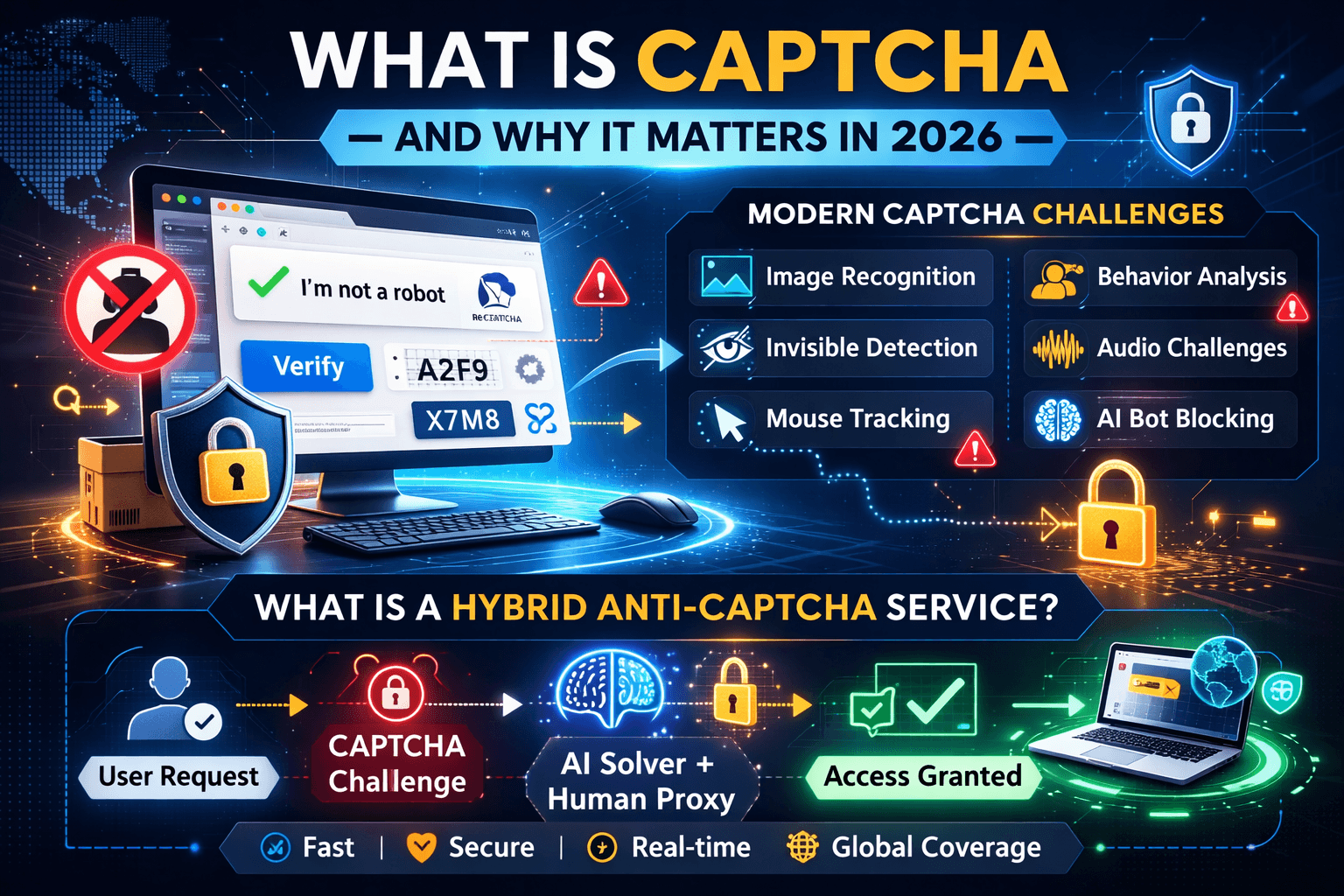
What Is CAPTCHA — and Why It Matters in 2026
CAPTCHA (Completely Automated Public Turing test to tell Computers and Humans Apart) is a protective mechanism websites use to block bots and automated access.
Modern challenges include:
- Image recognition CAPTCHAs
- Invisible bot-detection
- Mouse movement tracking
- Audio challenges
- Behavioral heuristics
In 2026, CAPTCHA systems have become more sophisticated, prompting innovations in bypass strategies.
What Is a Hybrid Anti-CAPTCHA Service?
Hybrid anti-CAPTCHA services combine human intelligence with automated solutions.
They typically work like this:
- Automation tries to solve the CAPTCHA.
- If automation fails or confidence is low, the CAPTCHA is routed to a human solver.
- The human solution is returned and fed back into the system.
Core Features
? Low error rate
? Higher success across challenging CAPTCHAs
? Human fallback for tough cases
? Flexible performance under varied conditions
Typical Workflow
Automated solver → Attempt
↓
Success? Yes → Return solution
No → Human team solves → Return solution
Pros
✔ Higher accuracy across complex CAPTCHA types
✔ Flexible and resilient
✔ Better success in edge cases (cluttered images, audio challenges)
Cons
⚠ Slower than fully automated systems
⚠ Potentially higher cost
⚠ Some delays during peak load
What Is a Fully Automated Anti-CAPTCHA Service?
Fully automated anti-CAPTCHA services attempt to solve every CAPTCHA using advanced algorithms and AI.
These systems use:
✔ Machine learning and neural nets
✔ Optical character recognition (OCR)
✔ Image classification models
✔ Pattern recognition and heuristics
They do not involve human intervention.
Core Features
? Instant solving
? Low latency
? Cost-efficient at scale
? AI-driven evolution
Pros
✔ Fastest response time
✔ Scalable cost per solve
✔ Ideal for high-volume operations
Cons
⚠ Lower success on ultra-complex CAPTCHAs
⚠ Less accurate on audio/text-distorted challenges
⚠ Can fail silently without fallback
Side-By-Side Comparison (2026 Edition)
Feature | Hybrid Anti-CAPTCHA | Fully Automated Anti-CAPTCHA |
Speed | Moderate | Very Fast |
Accuracy | High | Medium-High |
Cost | Higher (human fallback) | Lower (AI only) |
Scalability | Medium | Excellent |
Reliability on tough CAPTCHA | Excellent | Variable |
Best for | Complex challenges, small teams | High-volume automation |
When to Choose Hybrid Anti-CAPTCHA
Hybrid systems shine in scenarios where reliability matters more than milliseconds:
- Enterprise QA testing
- E-commerce scraping with heavy CAPTCHA
- High-value data extraction Edge case compliance testing
- Next-gen bot farms with variable complexity
Best for: Environments where occasional human correction prevents failures and wasted automation cycles.
When to Choose Fully Automated Anti-CAPTCHA
Fully automated solutions are ideal in environments where speed and cost efficiency outweigh occasional misses:
- High-volume scraping Continuous integration automatio
- Large-scale bot operations
- Time-sensitive workflows where milliseconds matter
Best for: Large data pipelines, continuous bots, and real-time automation.
Real-World Use Cases (2026)
Hybrid in Action
An e-commerce research team uses hybrid anti-CAPTCHA to extract pricing data across multiple international portals with advanced image/text CAPTCHAs. Hybrid fallback enures data integrity on the toughest challenges.
A mobile app testing suite uses hybrid services to automatically validate flows across thousands of devices, with human fallback ensuring edge case coverage.
Fully Automated in Action
A market intelligence bot processes 10M+ data points per month with fully automated CAPTCHA solving — maximizing throughput and minimizing cost.
A quality assurance pipeline runs fully automated CAPTCHA solving for rapid regression testing on development branches multiple times per day.
Cost Considerations (2026)
System Type | Cost Per Solve | Monthly Scale | Predictability |
Hybrid | High | Medium | Moderate |
Fully Automated | Low | High | High |
Hybrid has premium pricing because human solvers are involved. Fully automated is more affordable at scale, especially for high-volume operations.
Performance Factors to Evaluate
When choosing an anti-CAPTCHA service, evaluate:
Accuracy
Measured by success rate on the toughest CAPTCHAs.
Speed
Response time per solve in milliseconds.
Cost Efficiency
Cost per solve × volume.
Scalability
Consistency under heavy loads.
Fallback Robustness
Does the system reroute failed solves?
Reporting & Analytics
Real-time performance data and logs.
Risks and Compliance
Bypassing CAPTCHA must be done in compliance with local laws and platform terms of service. Misuse can lead to:
Legal repercussions
Ensure your automation strategy respects platform policies and data usage agreements.
The Future of Anti-CAPTCHA in 2026
Looking ahead:
- AI models continue to improve
- Hybrid systems become more dynamic
- Fully automated engines adopt adaptive learning
- CAPTCHA providers evolve defenses
As anti-CAPTCHA technologies mature, the balance between speed, accuracy, and cost will continue to shape adoption.
Final Verdict
Both Hybrid and Fully Automated anti-CAPTCHA services have their place in 2026 workflows:
Hybrid: Best where accuracy & reliability matter
Fully Automated: Best where speed & scale matter
Your choice depends on your priorities — speed, budget, accuracy, or volume.

 Multi-Account Management
 Prevent Account Association
 Multi-Employee Management
Recommended
See More