Proxy for E-Commerce Monitoring: Complete Price Tracking Guide 2026
 2026.02.27 20:43
 petro
petroThe e-commerce battlefield in 2026 is more competitive than ever. With AI-driven pricing algorithms, dynamic discounts, flash sales, and global marketplaces, monitoring competitor prices is no longer optional — it’s essential.
But here’s the challenge: most online stores actively block price tracking tools.
That’s where proxies for e-commerce monitoring become critical.
In this complete 2026 guide, you’ll learn:
What e-commerce monitoring proxies are
Why businesses need them
The best proxy types for price tracking
How to set up a reliable monitoring system
Legal and ethical considerations
Trends shaping price intelligence in 2026
What Is a Proxy for E-Commerce Monitoring?
A proxy server acts as an intermediary between your scraper or monitoring software and the target e-commerce website.
Instead of sending requests directly from your IP address, the proxy routes traffic through another IP. This makes your requests appear as if they are coming from different users in different locations.
For price monitoring, proxies allow you to:
Avoid IP bans
Bypass geo-restrictions
Collect location-based pricing
Scale large scraping operations
Mimic real customer behavior
Without proxies, most price tracking systems fail quickly due to anti-bot protections.
Why Price Tracking Matters More in 2026
E-commerce pricing is now:
Dynamic (changes multiple times per day)
AI-driven (algorithmic adjustments)
Personalized (varies by region and user behavior)
Marketplace-dependent (Amazon, Walmart, Shopify, etc.)
Retailers use automated repricing tools that react instantly to competitor changes. If you’re not monitoring prices in real time, you’re losing revenue opportunities.
Use cases include:
Competitive price monitoring
MAP compliance tracking
Distributor price monitoring
Flash sale detection
Cross-border pricing analysis
Brand protection
Types of Proxies for E-Commerce Monitoring
Not all proxies are suitable for price tracking. Here’s what works best in 2026:
1. Residential Proxies (Best Overall)
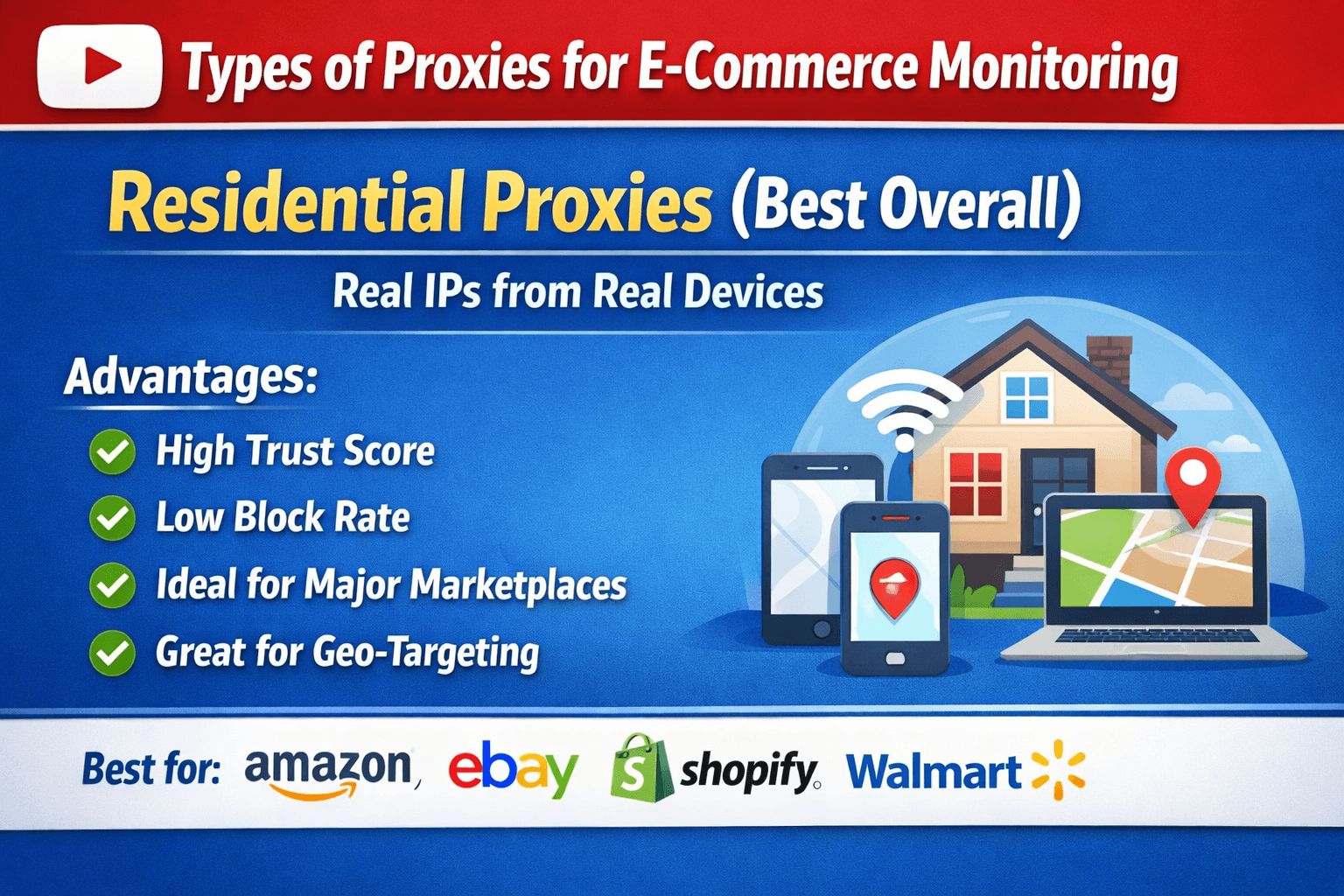
Residential proxies use real IP addresses from real devices.
Advantages:
High trust score
Low block rate
Ideal for major marketplaces
Great for geo-targeting
Best for: Amazon, eBay, Shopify, Walmart, and global retailers.
2. Mobile Proxies (Highest Anonymity)

Mobile proxies route traffic through real mobile devices using 4G/5G networks.
Advantages:
Extremely hard to detect
Best for strict anti-bot systems
Works well for sneaker and limited-edition monitoring
Best for: High-security platforms and mobile-specific pricing.
3. Datacenter Proxies (Budget Option)
Datacenter proxies are fast and affordable but easier to detect.
Advantages:
High speed
Low cost
Great for small-scale projects
Disadvantages:
Higher block rates
Not ideal for large marketplaces
Best for: Small retailers with weaker anti-bot systems.
Key Features to Look for in 2026
When choosing a proxy provider for e-commerce monitoring, look for:
Large IP pool (millions of IPs)
Geo-targeting (country, city, ASN)
IP rotation (automatic rotation per request)
High uptime (99%+)
Sticky sessions option
API integration support
Fast response time
Ethical sourcing transparency
Avoid providers that don’t disclose how their residential IPs are obtained.
How to Set Up a Price Monitoring System with Proxies
Here’s a simplified step-by-step process:
Step 1: Choose Your Proxy Type
Residential proxies are recommended for most use cases.
Step 2: Select a Scraping Tool
Options include:
Custom Python scraper (Scrapy, Selenium, Playwright)
Dedicated price intelligence platforms
Headless browser automation tools
Step 3: Configure Proxy Rotation
Rotate IP addresses:
Every request (high security sites)
Every session (less strict sites)
Step 4: Implement User-Agent Rotation
Combine proxies with:
Rotating user agents
Randomized request timing
Browser fingerprint management
Step 5: Store and Analyze Data
Use:
Cloud databases
BI dashboards
AI pricing optimization tools
Common Challenges in 2026
E-commerce websites use advanced anti-bot techniques such as:
CAPTCHA challenges
Behavioral fingerprinting
JavaScript rendering checks
TLS fingerprinting
AI traffic detection
To overcome these:
Use rotating residential proxies
Integrate CAPTCHA-solving solutions
Use headless browsers with stealth plugins
Monitor request patterns carefully
Legal and Ethical Considerations
Price monitoring itself is legal in most jurisdictions, but how you collect data matters.
Best practices:
Respect robots.txt when applicable
Avoid overwhelming servers
Do not scrape personal customer data
Follow marketplace terms of service
Consult legal counsel for large-scale operations
Ethical data collection ensures long-term sustainability.
Cost of Proxies for Price Tracking in 2026
Costs vary based on:
Traffic volume (GB usage)
IP type (residential vs mobile)
Geographic targeting
Concurrency needs
Typical pricing ranges:
Datacenter proxies: Low cost
Residential proxies: Mid to high range
Mobile proxies: Premium pricing
Always test providers before scaling.
Future Trends in E-Commerce Monitoring
In 2026 and beyond, we’re seeing:
AI-powered scraping detection
Proxy + AI behavior simulation
Decentralized proxy networks
Real-time pricing intelligence dashboards
Predictive competitor pricing models
Companies that combine proxy infrastructure with AI analytics will dominate competitive markets.
Final Thoughts
Proxies are no longer optional tools — they are the backbone of modern e-commerce monitoring.
Whether you’re a retailer, brand owner, marketplace seller, or price intelligence company, investing in the right proxy infrastructure determines how accurately and efficiently you can track competitor pricing in 2026.
The key is balance:
Reliable proxy provider
Smart scraping strategy
Ethical data practices
Strong analytics layer
Master these elements, and you gain a powerful competitive advantage.

 Multi-Account Management
 Prevent Account Association
 Multi-Employee Management
Recommended
See More