How to Scrape Google Search in 2026: Safe and Compliant SERP Data Collection
 2026.06.28 23:36
 petro
petroHow to Scrape Google Search in 2026: Safe, Legal, and Reliable Methods
Scraping Google Search means collecting search result data such as page titles, URLs, snippets, rankings, related queries, or SERP features. Businesses use this data for SEO research, competitor analysis, keyword tracking, market monitoring, and content strategy.
However, Google Search is not a normal website to scrape aggressively. Google’s terms warn against abusing, disrupting, bypassing protective measures, or using automated access in ways that violate machine-readable instructions such as robots.txt. Google also states that access may be suspended or terminated for conduct that causes harm, including scraping content that does not belong to you.
For that reason, the best way to scrape Google Search in 2026 is to use official APIs, compliant SERP data providers, or permission-based SEO tools instead of uncontrolled bots.
What Does Google Search Scraping Mean?
Google Search scraping usually means collecting data from search engine result pages, also called SERPs.
Common data points include:
Data Type | Example |
Organic ranking | Position 1, 2, 3, etc. |
Page title | Title shown in Google results |
Result URL | Ranking page link |
Meta snippet | Short description shown under the title |
Featured snippet | Answer box result |
People Also Ask | Related questions |
Local results | Map pack listings |
Shopping results | Product listings |
Image/video results | Visual SERP features |
Ads visibility | Sponsored result placement |
This information can help SEO teams understand which pages rank, which competitors dominate keywords, and what type of content Google is rewarding.
Is Scraping Google Search Legal?
The answer depends on the method, location, purpose, scale, and whether the activity violates platform terms or technical restrictions. This article is informational, not legal advice.
A safe approach is to avoid bypassing Google’s anti-bot systems, avoiding CAPTCHA circumvention, avoiding fake user behavior, and avoiding collection of content you do not have permission to reuse. Google’s current terms specifically mention not bypassing systems or protective measures and not using automated means to access content in violation of machine-readable instructions.
craping is also more visible. Google filed a lawsuit against SerpApi in December 2025 over large-scale search result scraping, while SerpApi later pushed back by arguing that Google itself scrapes public web content. This dispute shows why businesses should treat SERP scraping as a compliance-sensitive activity, not a simple technical task.
Best Methods to Collect Google Search Data
1. Use Google’s Official APIs
The safest technical route is to use official Google APIs where they fit your use case. Google’s Custom Search JSON API allows programmatic retrieval of web and image search results from a Programmable Search Engine in JSON format, and it requires a configured search engine ID and API key.
Important note: Google says the Custom Search JSON API is closed to new customers, and existing customers have until January 1, 2027 to transition to an alternative solution. Google also points users toward Vertex AI Search for searching up to 50 domains, or contacting Google for full web search needs.
Best for:
- Site search
- Limited domain search
- Internal tools
- Research dashboards
- Controlled applications
- Developers who need structured JSON results
Basic API logic:
User query → API request → JSON response → extract title, link, snippet → store results
Example data fields:
keywordrank_position
title
url
snippet
date_checked
device
country
language
2. Use Google Search Console for Your Own Website
If your goal is to track your own rankings and traffic, Google Search Console is often better than scraping.
It can help you monitor:
- Search queries bringing traffic
- Average position
- Impressions
- Clicks
- CTR
- Page performance
- Indexing problems
- Technical SEO issues
This is not the same as scraping all Google results, but it is safer and more accurate for your own domain.
Best for:
- Website owners
- SEO audits
- Content performance tracking
- Keyword improvement
- Indexing checks
3. Use SEO Platforms and SERP Data Providers
Many SEO tools collect and process SERP data for keyword tracking, competitor research, and ranking analysis. These platforms usually handle infrastructure, compliance review, data formatting, and historical storage.
Examples of use cases:
- Daily keyword rank tracking
- Competitor monitoring
- Local SEO tracking
- Featured snippet analysis
- SERP feature detection
- Market research
- Content gap analysis
This method is useful if you need SERP data but do not want to build and maintain your own collection system.
4. Scrape Only Where You Have Permission
If you need to collect search-style data from a website or internal search engine you own, scraping may be acceptable when you control the system.
Examples:
- Your own website search results
- Your own ecommerce search pages
- Internal knowledge base search
- Partner websites with permission
- Public datasets with clear usage rights
Always check robots.txt, terms of service, rate limits, copyright rules, and privacy obligations before collecting data.
Google’s own Search Central documentation explains that robots.txt is used to manage crawler traffic, which is one reason responsible crawlers check it before accessing pages at scale. (Google for Developers)
What You Should Avoid
Avoid unsafe Google scraping practices such as:
| Risky Method | Why to Avoid It |
|---|---|
| CAPTCHA bypass | Violates trust and may break platform rules |
| Rotating fake identities | Can look deceptive |
| Free proxy lists | Often abused, blocked, or unsafe |
| Headless bots at scale | Commonly detected by anti-bot systems |
| Ignoring robots.txt | Creates compliance and blocking risk |
| Scraping ads or protected modules | May involve additional legal and data-use risks |
| Reusing snippets as your own content | Can create copyright and quality problems |
| High-frequency automated requests | Can cause IP bans or account restrictions |
The goal should not be to “force” Google to return data. The goal should be to collect only the data you are allowed to use, with the least technical and legal risk.
Safe Workflow for Google Search Data Collection
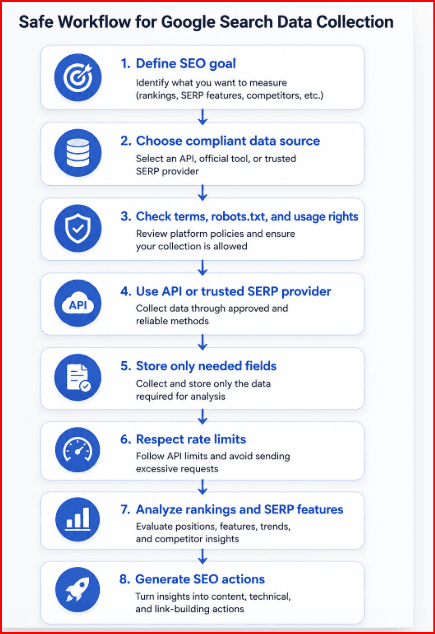
A professional workflow should look like this:
Define SEO goal
↓
Choose compliant data source
↓
Check terms, robots.txt, and usage rights
↓
Use API or trusted SERP provider
↓
Store only needed fields
↓
Respect rate limits
↓
Analyze rankings and SERP features
↓
Generate SEO actions
This approach is better than building a fragile scraper that constantly triggers blocks, CAPTCHAs, and inconsistent results.
How to Structure SERP Data
For SEO analysis, store clean and simple fields:
Field | Description |
keyword | Search query |
country | Target country |
language | Search language |
device | Desktop or mobile |
date | Date checked |
rank | Organic position |
title | Result title |
url | Ranking page URL |
domain | Website domain |
snippet | Visible description |
serp_feature | Featured snippet, PAA, video, local pack, etc. |
This makes it easier to compare keyword rankings over time.
Common SEO Use Cases
Keyword Rank Tracking
SEO teams track keywords to see whether pages move up or down in Google results.
Example:
Keyword: best mobile proxies
Domain: example.com
Current rank: 6
Previous rank: 9
Change: +3 positions
Competitor Analysis
SERP data can show which competitors appear repeatedly for valuable keywords.
You can analyze:
- Which domains rank most often
- Which pages win featured snippets
- Which content formats perform well
- Which competitors dominate commercial keywords
- Which pages gain or lose visibility
Content Gap Research
Search result data helps identify missing content opportunities.
For example, if competitors rank for “best residential proxies,” “mobile proxy for Instagram,” and “rotating proxies for scraping,” but your site does not have strong pages for these terms, those keywords may become content priorities.
SERP Feature Monitoring
Google results are no longer only blue links. Modern SERPs may include:
- Featured snippets
- People Also Ask
- Videos
- Images
- Local packs
- Shopping modules
- Discussions and forums
- News boxes
Tracking these features helps you understand what kind of content Google prefers for each keyword.
Example: Safe API-Based Collection Process
A compliant SERP collection system should focus on official or licensed data sources.
Basic process:
1. Prepare keyword list
2. Select country, language, and device
3. Send request through approved API or provider
4. Parse structured response
5. Save title, URL, snippet, position, and SERP features
6. Compare results with previous checks
7. Create SEO recommendations
Example output:
Keyword | Rank | URL | SERP Feature | Action |
best proxy providers | 4 | /best-proxy-providers | Organic | Improve comparison table |
mobile proxies | 8 | /mobile-proxies | People Also Ask | Add FAQ section |
datacenter proxies | 11 | /datacenter-proxies | Organic | Improve internal links |
rotating proxies | 5 | /rotating-proxies | Featured snippet | Optimize intro answer |
Best Practices for SEO Teams
To collect search data safely:
- Use official APIs where possible
- Use licensed SERP data providers for large projects
- Avoid CAPTCHA bypass and fake browsing behavior
- Track only the keywords you actually need
- Store structured data, not full copied pages
- Separate organic, paid, local, and SERP feature results
- Respect rate limits and usage terms
- Keep historical ranking snapshots
- Use data for analysis, not content copying
- Review legal and compliance requirements before scaling
Final Verdict
Scraping Google Search in 2026 should be treated as a compliance-sensitive SEO workflow, not just a coding trick. Direct, aggressive scraping can trigger CAPTCHAs, IP blocks, account restrictions, and legal risk.
The best approach is to use official APIs, Google Search Console for your own website, trusted SEO platforms, or licensed SERP data providers. This gives you cleaner data, fewer technical problems, and a safer long-term strategy.
For SEO teams, the real value is not simply collecting Google results. The value is turning SERP data into better content, smarter keyword targeting, stronger internal linking, and improved search visibility.
Use the BitBrowser to easily bypass platform anti-association detection, giving every profile an independent digital fingerprint.

 Multi-Account Management
 Prevent Account Association
 Multi-Employee Management
Recommended
See More