Google Voice Review 2026: Is It Still Worth Your Time and Money
 2026.07.28 10:05
 YT.Shi
Google Voice has been around since 2009, and in 2026, it remains one of the most searched free VoIP services on the internet. But after all these years, is it still a service you should rely on? The short answer is yes for many people, but with some important caveats.
This year brought some of the biggest changes to Google Voice in nearly a decade. The service introduced paid personal plans for the first time, added AI-powered features through Gemini, and continued to refine its calling experience. However, it also left one glaring issue unaddressed that has users frustrated.
Let us break down everything you need to know about Google Voice in 2026.
What Is Google Voice?
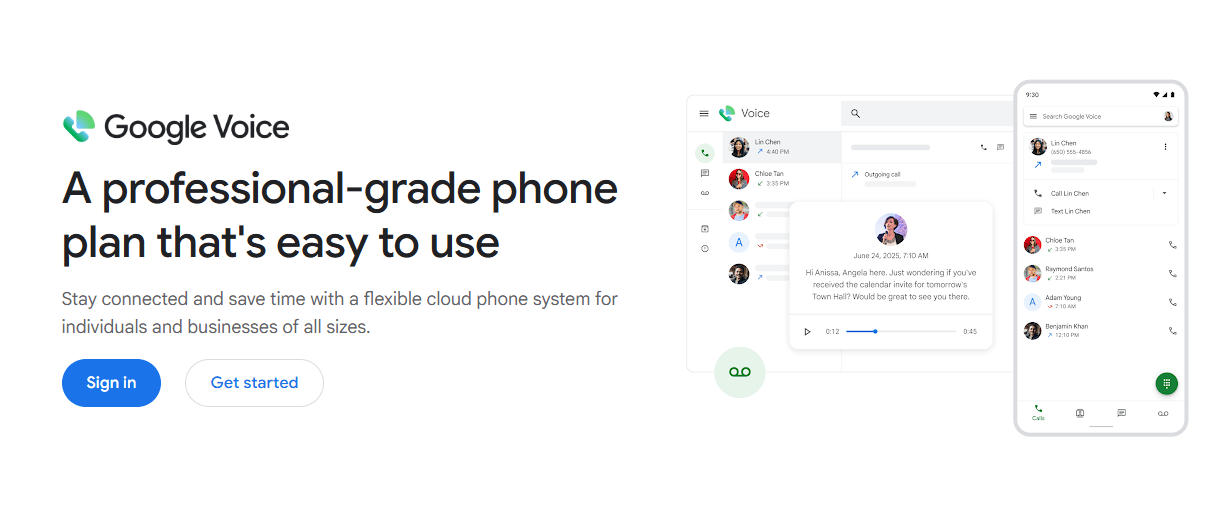
Google Voice is a VoIP service that gives you a secondary US phone number for making calls, sending texts, and receiving voicemails over the internet. You do not need a second SIM card or an extra phone. The service converts your voice into a digital signal that travels over the internet, and your calls can be forwarded to your actual phone, answered in your browser, or managed through the app.
What makes it appealing is the cross device sync. You can use the same number across your smartphone, computer, and tablet, and all your conversations stay in sync. This flexibility is one of the main reasons people keep coming back to Google Voice.
Google Voice Pricing in 2026
Google Voice now offers two pricing options: Voice Only for individuals and Google Voice for Workspace for businesses and teams.
● Voice Only can be purchased directly with a personal Gmail account and does not require Google Workspace. It offers three plans: Free, Starter ($10/month), and Standard ($20/month).
● Google Voice for Workspace requires an active Google Workspace subscription and is billed separately on a per-user basis. It includes Starter ($10/user/month), Standard ($20/user/month), and Premier ($30/user/month).
1. Voice Only (Personal Plans)
Google introduced standalone Google Voice plans in July 2026, allowing personal Gmail users in the US to access premium calling features without a Google Workspace subscription.
Free Google Voice
The free plan includes a US phone number, unlimited domestic calls and texts, voicemail transcription, spam filtering, and call forwarding. You still need an existing US phone number to activate your account.
Voice Starter ($10/month)
Voice Starter includes everything in the free plan, plus premium features such as three way calling, call recording, desk phone and ATA support, 911 emergency support, and no longer requires another phone number to verify your account.
Voice Standard ($20/month)
Voice Standard includes everything in Starter, along with Auto Attendants for handling incoming calls automatically. Like Starter, it supports a single user with a personal Gmail account and does not require Google Workspace.
These standalone plans are currently available only to eligible personal Gmail users in the United States.
2. Google Voice for Workspace (Business Plans)
Businesses can also add Google Voice to a Google Workspace subscription.
| Plan | Price |
|---|---|
| Starter | $10/user/month |
| Standard | $20/user/month |
| Premier | $30/user/month |
These plans require an active Google Workspace subscription, so the total monthly cost includes both the Workspace license and the Google Voice add-on.
What Google Voice Does Well
Reliable call quality. Google Voice generally delivers clear and stable calls over a good internet connection. Independent reviews and user feedback consistently rate its voice quality highly for everyday communication.
A genuinely free personal plan. Personal users can get a free US phone number with unlimited domestic calls and texts, voicemail transcription, call forwarding, and spam filtering, all without a monthly fee.
Easy to set up. After verifying your eligibility, choosing a phone number and getting started typically takes only a few minutes.
Useful voicemail transcription. Google Voice automatically converts voicemails into text, making it easier to review messages without listening to audio. Transcripts are available in the Voice app and can also be sent by email.
Convenient cross-device access. Calls, texts, and voicemails sync across the web and mobile apps, allowing you to switch between devices with minimal interruption.
Where Google Voice Falls Short
No RCS support. One of Google Voice's biggest limitations in 2026 is the lack of Rich Communication Services (RCS). Messages are still sent using SMS and MMS, so features like read receipts, typing indicators, message reactions, and high quality media sharing are unavailable.
Occasional performance issues. Some users report crashes, delayed notifications, slow syncing, or other minor bugs. While overall stability has improved, the experience can still be inconsistent across devices.
Limited enterprise features. Google Voice works well for small teams, but organizations with advanced telephony needs may find it lacking. Features such as live call monitoring, call whisper, advanced routing, and contact center capabilities are better supported by dedicated business VoIP platforms.
Limited desk phone compatibility. Google Voice supports a selection of certified desk phones and ATAs, but its hardware compatibility is more limited than many traditional business phone systems.
User Reviews: What People Are Saying
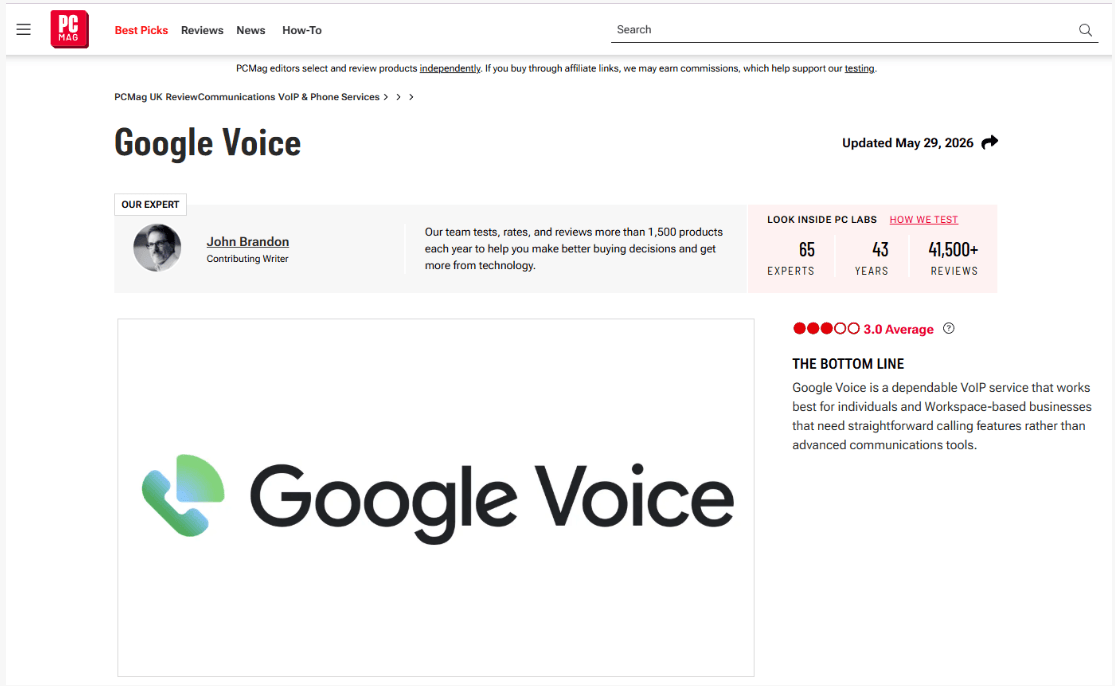
Overall, user feedback on Google Voice is positive, particularly among freelancers and individuals who need a free secondary phone number. Many users praise its reliable call quality, simple setup, and the convenience of separating work and personal communications without paying a monthly fee.
The most common complaints involve the lack of RCS support and occasional app performance issues. Users have reported slow loading times, delayed notifications, and minor bugs, while many Android users remain frustrated that Google Voice still relies on SMS and MMS instead of supporting modern messaging features.
Overall, most users agree that Google Voice remains an excellent free VoIP service for basic calling and texting. However, for advanced messaging, business telephony, or large scale account management, its limitations have become more noticeable as competing services continue to evolve.
Who Should Use Google Voice in 2026?
Google Voice is a good choice if you:
● Need a free or affordable US phone number for personal use
● Want to separate work and personal calls without carrying a second phone
● Primarily use voice calls and SMS rather than advanced messaging features
● Are a freelancer, contractor, or small business owner looking for a simple VoIP solution
● Already use Gmail or other Google services and want seamless integration
You should consider alternatives if you:
● Rely heavily on group messaging and want modern RCS features
● Need reliable SMS verification for platforms like WhatsApp, Instagram, or TikTok
● Require toll-free numbers, CRM integrations, or advanced business phone features
● Manage a large team or need sophisticated call routing, analytics, or contact center capabilities
The Bottom Line
Google Voice remains one of the best free VoIP services available in 2026. It offers reliable calling, a free US phone number, useful features like voicemail transcription and call forwarding, and convenient access across the web and mobile devices. The introduction of standalone paid plans also gives individual users more flexibility without requiring a Google Workspace subscription.
Its biggest drawback is the lack of RCS support, which makes messaging feel outdated compared with modern communication apps. Businesses with advanced telephony needs or users who rely on SMS verification for social media platforms may also find its limitations restrictive.
Overall, Google Voice is an excellent choice for individuals, freelancers, and small businesses looking for a simple and affordable phone solution. If your needs extend beyond basic calling and texting, however, you may be better served by a more feature rich VoIP provider.
Where BitBrowser Fits In
Google Voice can provide a secondary phone number, but a phone number is only one part of managing online accounts. Platforms like Google, Instagram, TikTok, and Facebook also evaluate your browser fingerprint, device information, IP address, cookies, and browsing behavior when determining whether an account is trustworthy.
Check Your Browser Fingerprint and IP Address
If you manage multiple Google accounts, simply using a different phone number is rarely enough. BitBrowser helps isolate each account with a dedicated browser profile, unique browser fingerprint, and independent proxy configuration, reducing the risk of accounts being linked together. Each profile maintains its own cookies, local storage, extensions, and browsing environment, allowing accounts to operate independently on the same computer.
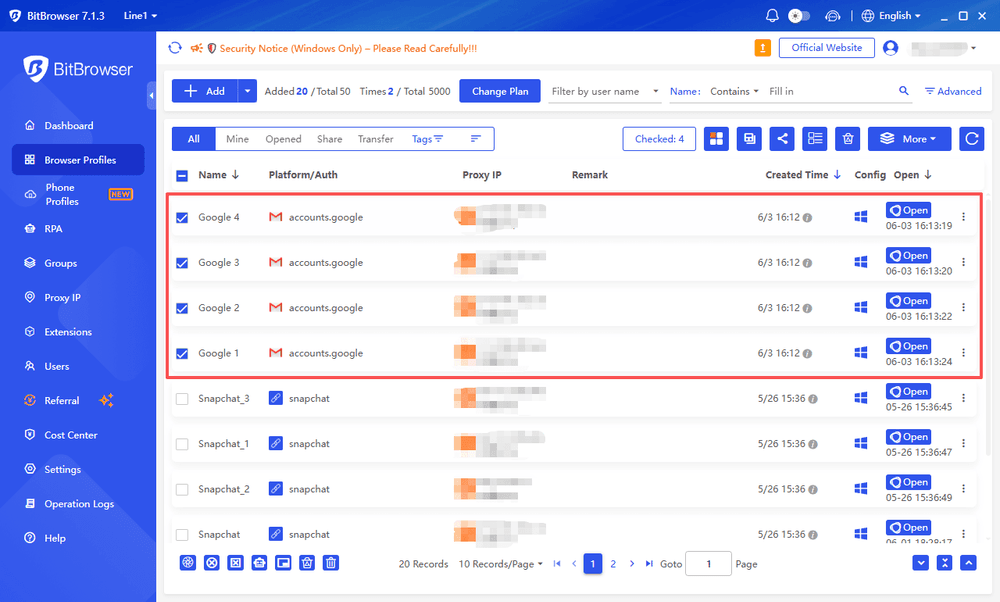
Beyond browser isolation, BitBrowser also includes built in proxy management, batch profile creation and import, team collaboration with role based permissions, API support, and RPA automation for repetitive workflows. These features make it easier to manage dozens or even hundreds of accounts efficiently while keeping each identity separated.
If your goal is to create a Gmail account without a phone number, keep in mind that Google Voice cannot be used to verify new Google accounts. In that case, you'll need to explore alternative verification methods. Once your accounts are created, BitBrowser can help keep them isolated for safer long term management.
Combined with a reliable phone verification service, BitBrowser provides a more complete account management setup by isolating the browser, device identity, and network environment, rather than relying on a phone number alone.
FAQ
1. Is Google Voice still free in 2026?
Yes. Google Voice still offers a free personal plan with a US phone number, unlimited domestic calls and texts, voicemail transcription, and call forwarding. Paid personal plans starting at $10/month are also available.
2. Can I use Google Voice to verify a Gmail account?
No. Google Voice numbers cannot be used to verify new Google accounts. You'll need a compatible mobile phone number or another supported verification method.
3. Does Google Voice work for WhatsApp, Instagram, or TikTok?
It depends. Google Voice may work on some platforms, but many services—including WhatsApp, Instagram, and TikTok—often reject VoIP numbers for SMS verification.
4. Does Google Voice support RCS messaging?
No. As of 2026, Google Voice still relies on SMS and MMS and does not support RCS features such as read receipts, typing indicators, or message reactions.
5. Who should use Google Voice?
Google Voice is best for individuals, freelancers, and small businesses that need an affordable US phone number for calling and texting. Businesses requiring advanced telephony features or users who need reliable SMS verification may be better served by other solutions.

 Multi-Account Management
 Prevent Account Association
 Multi-Employee Management
Recommended
See More